Dish guides
What is khao soi?
ข้าวซอย · khao soi
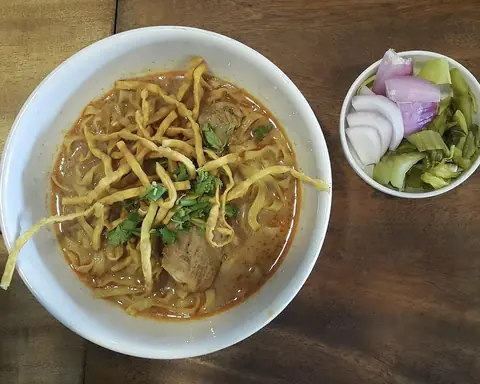
Khao soi is the signature noodle dish of Chiang Mai and northern Thailand: soft wheat-and-egg noodles in a rich, mildly spiced coconut-milk curry broth, usually with a chicken drumstick or beef, topped with a tangle of deep-fried crispy noodles. It's served with pickled mustard greens, shallots, lime and roasted chilli paste so you can adjust the taste yourself.
- At a glance
- Khao soi
- Northern Thai curry noodle soup of egg noodles in coconut broth, topped with crispy noodles.
- Pronunciation
- Say it like cow soy · IPA /kʰâːw sɔ̄ːj/
- Also written as
- khao soy, khao soi kai (with chicken), ข้าวซอยไก่, khao soi nuea (with beef), ข้าวซอยเนื้อ, khao soi Islam, Chiang Mai curry noodles
What’s in it
Core ingredients
- wheat-and-egg noodles, boiled
- the same noodles deep-fried as a crispy topping
- curry broth: dried chillies, shallots, garlic, turmeric, ginger, coriander seed and curry powder
- coconut milk
- chicken (often a drumstick) or beef
Often added
- fish sauce or soy sauce
- pickled mustard greens (phak kat dong) on the side
- raw shallots
- lime wedges
- roasted chilli paste in oil
- pork (in some non-Muslim shops)
- shrimp paste (in the red curry paste many shops use)
Allergens
| Allergen | How likely |
|---|---|
| Gluten | Typically contains |
| Eggs | Typically contains |
| Fish | Often contains |
| Shellfish | Often contains |
| Mustard | Often contains |
| Soy | Sometimes contains |
| Dairy | Rarely contains |
| Peanuts | Rarely contains |
| Tree nuts | Rarely contains |
| Sesame | Rarely contains |
| Molluscs | Rarely contains |
| Diet | Suitable? |
|---|---|
| Vegetarian | Depends — Some places in Chiang Mai offer a vegetable or tofu khao soi, but the broth is usually made with chicken or beef and seasoned with fish sauce; ask about both. |
| Vegan | Depends — Rare: the standard noodles contain egg, so a vegan version needs rice noodles as well as a meat-free, fish-sauce-free broth. |
| Pescatarian | Depends — Only a vegetarian or seafood version, since the standard broth is cooked with chicken or beef. |
| Halal | Depends — Khao soi is usually traced to Chinese Muslim traders from Yunnan, and many well-known shops in Chiang Mai are Muslim-run and serve halal chicken and beef. Many other shops now also serve pork, so ask. |
| Kosher | No |
| Gluten-free | No |
Allergen and calorie details are AI estimates based on the menu and typical recipes. They can be incomplete — if you have a serious allergy, always check with the staff.
What's in a bowl of khao soi
The broth starts with a curry paste of dried chillies, shallots, garlic, turmeric, ginger and coriander seed, often with curry powder, fried and then simmered with coconut milk and chicken or beef until rich and golden-orange. It's thinner than a typical curry and milder than green curry. Boiled egg noodles go into the bowl, the broth and meat over them, and a nest of the same noodles, deep-fried until crisp, on top.
The side plate matters: pickled mustard greens (phak kat dong), raw shallots, lime and roasted chilli paste in oil. Add them a little at a time; the sourness and crunch balance the rich broth. The greens are the leaves of a mustard plant, and allergy charities advise people with a mustard allergy to avoid every part of the plant, so leave them out if that applies to you. Many shops now build the broth on ready-made red curry paste, which usually contains shrimp paste.
A northern dish with Muslim roots
Khao soi is usually linked to the Chin Haw, Chinese Muslim traders from Yunnan who travelled the caravan routes through Burma, Laos and northern Thailand. That's why many of Chiang Mai's best-known khao soi shops are Muslim-run, and why chicken and beef are standard rather than pork. A close relative, ohn no khao swè, is eaten in Myanmar.
In Chiang Mai, khao soi is a cheap one-bowl meal at noodle shops and markets, most often eaten at lunchtime; elsewhere in Thailand look for it at northern-style restaurants. Choose kai (chicken) or nuea (beef), and in some shops mu (pork). See the Thailand menu guide for northern dishes such as sai ua sausage.
How to order it
| Phrase | Romanization | Meaning |
|---|---|---|
| ขอข้าวซอยไก่หนึ่งชามครับ | Kho khao soi kai nueng cham khrap. | One bowl of khao soi with chicken, please. (Women say kha instead of khrap.) |
| เส้นมีไข่ไหมครับ | Sen mi khai mai khrap? | Do the noodles contain egg? |
| น้ำแกงใส่กะปิไหมครับ | Nam kaeng sai kapi mai khrap? | Is there shrimp paste in the curry broth? |
Not to be confused with
- Lao khao soi — A different dish with the same name from northern Laos: rice noodles in clear broth topped with a minced pork and tomato sauce; no coconut.
- Khanom chin nam ngiao — Another northern Thai noodle dish: fermented rice noodles in a tomato and pork broth with dried flowers and chilli.
- Laksa — Malaysian and Singaporean coconut curry noodle soup, usually with prawns, tofu puffs and rice noodles.
Frequently asked questions
Is khao soi spicy?
Usually only medium. The curry broth is warming and aromatic, softened by coconut milk, and most of the heat comes from the roasted chilli paste served on the side, which you add yourself. If you're sensitive to chilli, taste the broth first and say "mai phet" (not spicy) when ordering.
Is khao soi gluten free?
No. The standard noodles are made from wheat flour and egg, both boiled and deep-fried, so khao soi contains gluten and egg. Some shops in the eastern north make a different version with rice noodles and no coconut, but that's a separate dish. Soy sauce in some broths can also contain wheat.
What's the difference between Thai and Lao khao soi?
They share a name but little else. Northern Thai khao soi is egg noodles in a coconut curry broth with crispy noodles on top. Lao khao soi, from Luang Prabang and northern Laos, is wide rice noodles in a clear broth with a minced pork and tomato sauce and fresh herbs. Ask which one a menu means.
How do you pronounce khao soi?
Say cow soy: in IPA, [kʰâːw sɔ̄ːj]. Khao has a falling tone and a breathy k, like the English "cow" said firmly, and soi is a level tone. The kh is never pronounced like the ch in Scottish "loch"; it's just a k with a puff of air.