Dish guides
What is pad thai?
ผัดไทย · phat thai
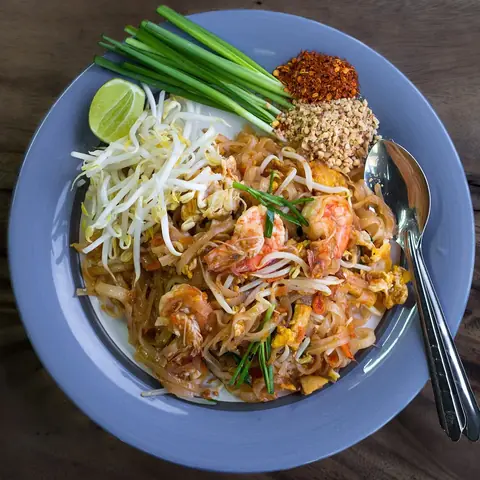
Pad thai is a Thai stir-fry of flat rice noodles with tamarind, fish sauce and palm sugar, tossed with egg, tofu, bean sprouts and garlic chives, and usually prawns. It's served with crushed peanuts, a wedge of lime and chilli flakes on the side, so you season it yourself. In Thailand it's everyday street food.
- At a glance
- Pad thai
- Thai stir-fried rice noodles with tamarind, fish sauce, egg, tofu and prawns, topped with peanuts.
- Pronunciation
- Say it like paht tie · IPA /pʰàt tʰāj/
- Also written as
- phad thai, phat thai, pad thai goong (ผัดไทยกุ้ง), pad thai kung sod (fresh prawns), pad thai tofu, pad thai chicken, ผัดไทยห่อไข่ (pad thai wrapped in egg)
What’s in it
Core ingredients
- flat rice noodles (sen chan or sen lek)
- tamarind
- fish sauce
- palm sugar
- egg
- firm tofu
- bean sprouts
- garlic chives
- crushed peanuts
Often added
- fresh prawns
- dried shrimp
- chicken
- sweet preserved radish
- shallots and garlic
- lime and chilli flakes on the side
- banana blossom and raw vegetables on the side
Allergens
| Allergen | How likely |
|---|---|
| Peanuts | Typically contains |
| Eggs | Typically contains |
| Fish | Typically contains |
| Shellfish | Typically contains |
| Soy | Typically contains |
| Molluscs | Sometimes contains |
| Gluten | Sometimes contains |
| Sesame | Rarely contains |
| Dairy | Rarely contains |
| Tree nuts | Rarely contains |
| Diet | Suitable? |
|---|---|
| Vegetarian | Depends — Vegetarian pad thai (often labelled jay or with tofu) swaps fish sauce for soy sauce; ordinary versions contain fish sauce and often dried shrimp. |
| Vegan | Depends — As for vegetarian, and ask for it without egg. |
| Pescatarian | Usually |
| Halal | Depends — The classic recipe has no pork, but ordinary stalls aren't halal-certified; halal versions are easy to find in southern Thailand and at Muslim-run restaurants. |
| Kosher | No |
| Gluten-free | Depends — Rice noodles, tamarind and fish sauce are normally wheat-free, but some cooks add soy or oyster sauce, which can contain wheat. |
Allergen and calorie details are AI estimates based on the menu and typical recipes. They can be incomplete — if you have a serious allergy, always check with the staff.
What pad thai looks like and how to season it
A good pad thai is glossy and pale reddish-brown from the tamarind, slightly sticky, with strands of egg, cubes of tofu and bright green chives running through the noodles. Prawns sit on top. The flavour balances sour, salty and sweet; it's not normally hot.
On the side you'll usually get crushed peanuts, a lime wedge, extra bean sprouts and sometimes a piece of banana blossom. Most Thai noodle stalls and restaurants also put out a condiment set (khrueang prung) of chilli flakes, sugar, fish sauce and vinegar with chillies, so you can adjust it to taste. If you're allergic to peanuts, say so before it's served: peanuts are sometimes sprinkled on top rather than on the side.
Versions you'll see on menus
- Pad thai kung (with prawns) is the most common; kung sot means fresh prawns, kung haeng dried shrimp.
- Pad thai ho khai is wrapped in a thin omelette.
- Pad thai jay or tofu pad thai is the vegetarian version.
- With chicken or mixed seafood (thale) on tourist menus.
Outside Thailand, pad thai is often sweeter, and some restaurants make the sauce with ketchup or more sugar instead of tamarind. In Thailand it's a one-plate meal ordered from street stalls and casual restaurants at any time of day.
Where pad thai comes from
Stir-fried rice noodles came to Thailand with Chinese immigrants, but pad thai as a named dish is fairly recent. It's usually linked to the government of Plaek Phibunsongkhram in the late 1930s and 1940s, which promoted a noodle dish with a "Thai" name as part of a nation-building campaign. Today it's one of the best-known Thai dishes at home and abroad. See the Thailand menu guide for more menu words.
How to order it
| Phrase | Romanization | Meaning |
|---|---|---|
| ขอผัดไทยกุ้งหนึ่งจานครับ | Kho phat thai kung nueng chan khrap. | One pad thai with prawns, please. (Women say kha instead of khrap.) |
| ไม่เผ็ดครับ | Mai phet khrap. | Not spicy, please. |
| ไม่ใส่ถั่วลิสงครับ | Mai sai thua lisong khrap. | No peanuts, please. |
Not to be confused with
- Pad see ew — Wide rice noodles stir-fried with dark soy sauce, egg and Chinese broccoli; smoky and savoury, no tamarind or peanuts.
- Pad kra pao — Minced meat stir-fried with holy basil and chilli, served over rice rather than with noodles.
- Pad woon sen — Glass noodles stir-fried with egg, vegetables and meat or seafood; milder and less sweet.
Frequently asked questions
Is pad thai spicy?
Not usually. Pad thai is sweet, sour and salty rather than hot, and most of the chilli is served on the side as dried flakes so you can add your own. Some cooks add a little chilli to the pan, so if you can't take any heat, say "mai phet" (not spicy) when you order.
Is pad thai gluten free?
It often is, but check. The noodles are rice, and the classic sauce of tamarind, fish sauce and palm sugar is normally wheat-free. Some cooks, especially outside Thailand, add soy sauce or oyster sauce, which can contain wheat, and woks are shared. Ask what goes into the sauce.
Does pad thai have peanuts?
Yes, typically. Crushed roasted peanuts are a standard garnish, either on the side or sprinkled on top, and some cooks add them to the pan or use peanut oil. If you have a peanut allergy, tell the cook before it's made, and keep in mind that utensils and woks are shared.
What's the difference between pad thai and pad see ew?
Pad thai uses thin to medium flat rice noodles in a tamarind, fish sauce and palm sugar sauce, with tofu, bean sprouts, egg and peanuts. Pad see ew uses wide, soft rice noodles stir-fried with dark sweet soy sauce, egg and Chinese broccoli. Pad see ew contains soy sauce and often wheat; pad thai usually doesn't.
How do you pronounce pad thai?
Say paht tie, two short words: in IPA, [pʰàt tʰāj]. The ph and th are just breathy p and t sounds, not f or the th in "thin". Phat has a low tone and thai a mid tone, but English speakers are easily understood without them.