Dish guides
What is pad kra pao?
ผัดกะเพรา · phat kaphrao
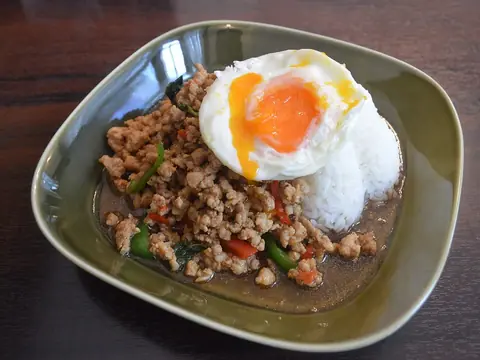
Pad kra pao is a Thai stir-fry of minced pork or chicken with holy basil, garlic and fresh chillies, seasoned with fish sauce and soy sauce and served over jasmine rice, usually with a crispy fried egg on top. It's one of the most-ordered one-plate meals in Thailand, cooked to order at street stalls in minutes.
- At a glance
- Pad kra pao
- Thai stir-fry of minced meat with holy basil, garlic and chilli, served on rice with a fried egg.
- Pronunciation
- Say it like paht gah-prao · IPA /pʰàt kà.pʰrāw/
- Also written as
- pad krapow, pad kaprao, pad gaprao, khao kaphrao (ข้าวกะเพรา), กะเพราหมูสับ (kaphrao mu sap, minced pork), กะเพราไก่ (kaphrao kai, chicken), กะเพราหมูกรอบ (kaphrao mu krop, crispy pork), กระเพรา, holy basil stir-fry
What’s in it
Core ingredients
- minced pork or chicken
- holy basil (bai kaphrao)
- garlic
- bird's eye chillies
- fish sauce
- soy sauce
- sugar
- jasmine rice
Often added
- fried egg (khai dao)
- oyster sauce
- dark sweet soy sauce
- long beans, onion or baby corn
- crispy pork belly, beef, prawns or squid instead of mince
- fish sauce with chillies (phrik nam pla) on the side
Allergens
| Allergen | How likely |
|---|---|
| Soy | Typically contains |
| Fish | Typically contains |
| Eggs | Often contains |
| Gluten | Often contains |
| Molluscs | Often contains |
| Shellfish | Sometimes contains |
| Peanuts | Rarely contains |
| Tree nuts | Rarely contains |
| Sesame | Rarely contains |
| Dairy | Rarely contains |
| Diet | Suitable? |
|---|---|
| Vegetarian | Depends — Tofu or mushroom versions exist at vegetarian (jay) restaurants; ordinary stalls season it with fish sauce and oyster sauce. |
| Vegan | Depends — As for vegetarian, and leave off the fried egg. |
| Pescatarian | Depends — Prawn, squid or seafood versions are common, but the same wok is used for pork and chicken. |
| Halal | Depends — Chicken and beef versions are easy to find, but pork is the most common and ordinary stalls aren't halal-certified; look for Muslim-run restaurants. |
| Kosher | No |
| Gluten-free | Depends — Rice, meat and basil are gluten-free, but most cooks use soy sauce and oyster sauce, which can contain wheat. |
Allergen and calorie details are AI estimates based on the menu and typical recipes. They can be incomplete — if you have a serious allergy, always check with the staff.
Holy basil is the point
Kaphrao is holy basil (Ocimum tenuiflorum), a peppery, slightly clove-like herb, not the sweet Thai basil (horapha) used in green curry. Thai cooks consider the holy basil essential. Many restaurants add onions, carrots or long beans, which plenty of Thai diners see as a way of stretching the meat; the classic version is just meat, garlic, chilli and a big handful of basil.
Expect it to be spicy: the chillies are pounded with garlic and fried first. Thai menus often write the name กระเพรา, a common misspelling of กะเพรา; both mean the same dish. On menus the meat comes after the word: kaphrao kai (chicken), kaphrao mu sap (minced pork), kaphrao mu krop (crispy pork belly), kaphrao nuea (beef), kaphrao thale (seafood).
How it's ordered and eaten
Pad kra pao is a classic ahan tam sang, a dish cooked to order at a street stall or casual restaurant. It comes as one plate: rice, the stir-fry beside it, and if you ask for khai dao, a fried egg with crispy edges and a runny yolk. A small bowl of fish sauce with sliced chillies (phrik nam pla) is usually on the table for extra seasoning. It's eaten with a spoon and fork, the Thai way: the fork pushes food onto the spoon.
It's a common lunch for office workers and a late-night meal. Some stalls also sell a khai jiao (Thai omelette) instead of a fried egg. More menu words are in the Thailand menu guide.
Where pad kra pao comes from
Like many Thai stir-fries, pad kra pao grew out of Chinese-Thai restaurant cooking in the early 20th century and became widely popular from the late 1950s. Today it's widely considered one of Thailand's national dishes.
How to order it
| Phrase | Romanization | Meaning |
|---|---|---|
| ขอข้าวกะเพราหมูสับไข่ดาวครับ | Kho khao kaphrao mu sap khai dao khrap. | Holy-basil stir-fry with minced pork on rice, with a fried egg, please. (Women say kha instead of khrap.) |
| เผ็ดน้อยครับ | Phet noi khrap. | Only a little spicy, please. |
| ใส่ซอสหอยนางรมไหมครับ | Sai sot hoi nangrom mai khrap? | Do you use oyster sauce? |
Not to be confused with
- Pad bai horapha — A similar stir-fry made with Thai sweet basil (horapha), which tastes of anise and is sweeter than peppery holy basil.
- Pad kee mao (drunken noodles) — Wide rice noodles stir-fried with holy basil, chilli and meat; the same flavours but with noodles.
- Pad thai — Rice noodles in a sweet-sour tamarind sauce with egg, tofu and peanuts; mild rather than chilli-hot.
Frequently asked questions
Is pad kra pao spicy?
Yes, it's usually one of the spicier everyday Thai dishes, because fresh bird's eye chillies are pounded with the garlic and fried at the start. You can ask for "phet noi" (a little spicy) or "mai phet" (not spicy), but a mild version still has some heat and lots of black-pepper-like flavour from the holy basil.
What's the difference between holy basil and Thai basil?
Holy basil (kaphrao) has soft, slightly fuzzy leaves and a peppery, clove-like taste; it's the herb in pad kra pao. Thai basil (horapha) has purple stems and a sweet, anise-like taste and goes into curries and pho. Restaurants outside Thailand sometimes use Thai basil because holy basil is harder to find.
Is pad kra pao gluten free?
Not reliably. The meat, garlic, chilli, basil and rice are gluten-free, but most cooks season the stir-fry with soy sauce and often oyster sauce, which can contain wheat. Some stalls use only fish sauce. If you need to avoid gluten, ask about the sauces before ordering.
How do you pronounce pad kra pao?
Say paht gah-prao: in IPA, [pʰàt kà.pʰrāw]. The k in kaphrao is unaspirated, so it sounds closer to an English g, and many Thai speakers drop the r, saying "ga-pao". The spelling "kra pao" on menus is a common romanisation rather than how it's said.