Dish guides
What is tom yum goong?
ต้มยำกุ้ง · tom yam kung
Tom yum goong is a hot and sour Thai soup with prawns, flavoured with lemongrass, galangal, kaffir lime leaves, chillies, lime juice and fish sauce. Tom yum is the soup family; goong (kung) means prawns, the classic version. It comes clear (nam sai) or creamy (nam khon) and is eaten with rice as part of a shared meal.
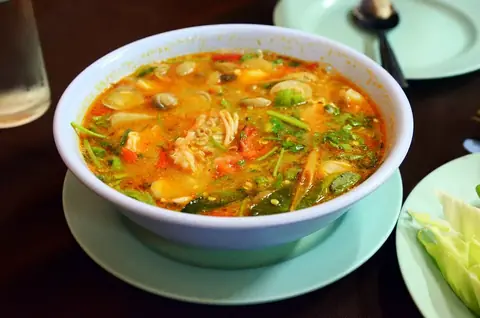
- At a glance
- Tom yum goong
- Hot and sour Thai prawn soup with lemongrass, galangal, lime leaves, chilli and lime.
- Pronunciation
- Say it like tohm yahm goong · IPA /tôm jām kûŋ/
- Also written as
- tom yum, tom yam, tom yam kung, tom yam goong, tom yum goong nam khon (creamy), tom yum talay (seafood), tom yum gai (chicken), ต้มยำ
What’s in it
Core ingredients
- prawns
- lemongrass
- galangal
- kaffir lime leaves
- bird's eye chillies
- lime juice
- fish sauce
Often added
- straw or oyster mushrooms
- nam phrik phao (roasted chilli paste, often with shrimp)
- evaporated milk, non-dairy creamer or coconut milk (nam khon)
- coriander leaves
- tomato and onion
- mixed seafood or chicken instead of prawns
Allergens
| Allergen | How likely |
|---|---|
| Shellfish | Typically contains |
| Fish | Typically contains |
| Dairy | Often contains |
| Molluscs | Sometimes contains |
| Soy | Sometimes contains |
| Gluten | Rarely contains |
| Eggs | Rarely contains |
| Peanuts | Rarely contains |
| Tree nuts | Rarely contains |
| Sesame | Rarely contains |
| Diet | Suitable? |
|---|---|
| Vegetarian | Depends — Mushroom or tofu tom yum exists, but it's normally made with fish sauce and a chilli paste that often contains shrimp; ask for a jay (vegetarian) version. |
| Vegan | Depends — As for vegetarian, and choose the clear version: the creamy one usually contains evaporated milk. |
| Pescatarian | Depends — The prawns are fine, but some kitchens make the broth with chicken or pork stock rather than water; ask what the stock is. |
| Halal | Depends — Prawns and seafood are widely accepted, but ordinary restaurants aren't halal-certified and the stock may be made from pork or chicken bones. |
| Kosher | No |
| Gluten-free | Usually |
Allergen and calorie details are AI estimates based on the menu and typical recipes. They can be incomplete — if you have a serious allergy, always check with the staff.
Clear or creamy: nam sai and nam khon
Menus and cooks may ask which kind you want:
- Nam sai (น้ำใส, "clear water"): a clear, bright, sharply sour and spicy broth.
- Nam khon (น้ำข้น, "thick water"): an orange, creamier broth made with roasted chilli paste (nam phrik phao) and evaporated milk, non-dairy creamer or sometimes coconut milk.
Prawns are the classic choice (kung / goong). You'll also see thale (mixed seafood, often with squid and mussels), kai (chicken), pla (fish) and het (mushroom). The soup comes in a bowl or sometimes a hotpot with a chimney, to share with rice and other dishes rather than as a starter.
How to eat it (and what not to eat)
The lemongrass stalks, slices of galangal and kaffir lime leaves are there for flavour and are normally left in the bowl; they're tough and woody, so push them aside. Spoon the broth and prawns over your rice or eat it on its own. Tom yum is spicy by default, so if you're sensitive to heat, ask for it less spicy (phet noi) when you order. More useful words are in the Thailand menu guide.
A Thai national dish
The name combines tom (to boil) and yam (a mixed, tossed dish, the same word used for Thai salads). In 2024, "Tomyum Kung" was added to UNESCO's Representative List of the Intangible Cultural Heritage of Humanity, recognising the dish and the knowledge behind it as part of Thai culture.
How to order it
| Phrase | Romanization | Meaning |
|---|---|---|
| ขอต้มยำกุ้งหนึ่งที่ครับ | Kho tom yam kung nueng thi khrap. | One tom yum goong, please. (Women say kha instead of khrap.) |
| เอาน้ำใสครับ | Ao nam sai khrap. | The clear version, please. |
| ใส่นมไหมครับ | Sai nom mai khrap? | Is there milk in it? |
Not to be confused with
- Tom kha gai — Chicken soup in coconut milk with the same herbs but led by galangal (kha); richer, milder and less sour.
- Tom saep — An Isan hot-and-sour soup, often with pork ribs or offal: clear, herby and very sour, without milk.
Frequently asked questions
What's the difference between tom yum and tom kha?
Tom yum is a hot and sour soup, usually with prawns, built on lemongrass, galangal, lime leaves, chilli and lime, either clear or with a little milk. Tom kha, usually with chicken (tom kha gai), uses the same herbs in a coconut-milk broth with more galangal (kha), so it's creamier, milder and less sour.
Is tom yum spicy?
Yes, it's usually quite spicy, with fresh bird's eye chillies and often a roasted chilli paste. The heat is balanced by lime juice and fish sauce. You can ask for it less spicy ("phet noi") or not spicy ("mai phet"), but some heat from the chilli paste usually stays.
Is tom yum gluten free?
It usually is. The broth, herbs, prawns, lime and fish sauce don't normally contain wheat. The risk is in shortcuts: some restaurants use ready-made tom yum paste, stock cubes or soy sauce that may contain wheat. If you need to avoid gluten strictly, ask whether they use a paste or seasoning sauce.
Does tom yum have coconut milk?
Not traditionally. The clear version (nam sai) has no milk at all, and the creamy version (nam khon) is most often made with evaporated milk (dairy) or non-dairy creamer, which often still contains milk protein. Some restaurants use coconut milk instead. If you avoid dairy, order it nam sai or ask what makes it creamy.