
Dish guides
What is larb?
ลาบ · lap
Larb (lap in Thai) is a warm salad of finely minced meat, most often pork or chicken, dressed with lime juice, fish sauce, dried chilli and toasted ground sticky rice, and tossed with shallots, mint and other fresh herbs. It's often called the national dish of Laos and is a staple of Isan in north-east Thailand, eaten with sticky rice and raw vegetables.
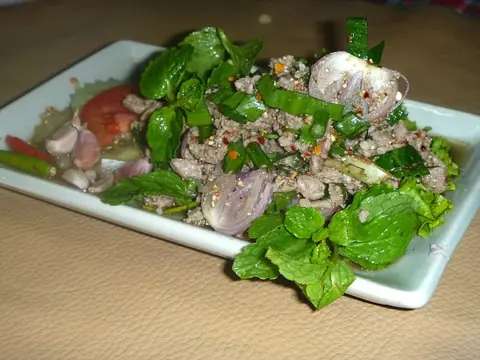
- At a glance
- Larb
- Minced meat salad with lime, fish sauce, chilli, toasted rice powder and fresh mint.
- Pronunciation
- Say it like lahb · IPA /lâːp/
- Also written as
- laab, laap, larp, lahb, ลาบหมู (lap mu, pork), ลาบไก่ (lap kai, chicken), ลาบเป็ด (lap pet, duck), ลาบเนื้อ (lap nuea, beef), ลาบปลาดุก (lap pla duk, catfish), lap mueang (northern style)
What’s in it
Core ingredients
- minced pork, chicken, duck, beef or fish, usually cooked
- lime juice
- fish sauce
- dried chilli flakes
- toasted ground sticky rice (khao khua)
- shallots
- mint
- spring onion, coriander or culantro
Often added
- pla ra (fermented fish sauce)
- offal or crispy pork skin
- prawns (lap kung)
- mushrooms or tofu (vegetarian versions)
- sticky rice
- raw cabbage, long beans, cucumber and herbs on the side
- northern spice mix with long pepper and prickly ash (lap mueang)
- raw meat or blood (lap dip, lap lueat)
Allergens
| Allergen | How likely |
|---|---|
| Fish | Typically contains |
| Shellfish | Sometimes contains |
| Gluten | Rarely contains |
| Soy | Rarely contains |
| Peanuts | Rarely contains |
| Tree nuts | Rarely contains |
| Dairy | Rarely contains |
| Eggs | Rarely contains |
| Sesame | Rarely contains |
| Molluscs | Rarely contains |
| Diet | Suitable? |
|---|---|
| Vegetarian | Depends — Mushroom or tofu larb appears on some menus, but the dressing is normally fish sauce; ask for soy sauce instead (mai sai nam pla). |
| Vegan | Depends — Same as vegetarian; the dish has no egg or dairy. |
| Pescatarian | Depends — Fish larb (for example with catfish) exists, especially in Isan, but pork and chicken are far more common. |
| Halal | Depends — Pork is the most common meat; chicken, beef and fish versions contain no pork but are rarely certified outside Muslim-run restaurants. |
| Kosher | No |
| Gluten-free | Usually — The usual ingredients are naturally wheat-free (the toasted powder is rice), but check that no soy sauce or seasoning sauce is added. |
Allergen and calorie details are AI estimates based on the menu and typical recipes. They can be incomplete — if you have a serious allergy, always check with the staff.
What goes into larb
The meat is chopped very fine, cooked briefly with a splash of water or stock, then dressed while warm with lime juice, fish sauce (and in Isan often pla ra, a pungent fermented fish sauce), dried chilli flakes and khao khua, sticky rice toasted in a dry pan and ground to a coarse, nutty powder. Sliced shallots, spring onion, coriander or culantro and plenty of mint go in last. The taste is sour, salty, hot and herby, with a little crunch from the rice.
It's eaten at room temperature or slightly warm, with a basket of sticky rice and raw vegetables such as cabbage, long beans and cucumber to cool the heat. Larb is also seen as a lucky dish: its name sounds like the Lao and Thai word for good fortune.
Styles, and the raw versions
Most larb in Thailand is the Isan and Lao style described above. Lap mueang, the northern style from Chiang Mai and the old Lanna kingdom, is different: it uses a dry spice mix with long pepper and prickly ash, often with blood and offal, and usually no lime or fish sauce, so it tastes salty and spicy rather than sour.
Some places, especially in the north and north-east, serve larb raw (lap dip) or with raw blood (lap lueat). Eating raw pork is a known risk factor for Streptococcus suis, a bacterial infection that can cause meningitis and lasting hearing loss, and studies in northern Thailand have linked cases to traditional raw pork dishes such as lu (raw pork with blood) and raw lap. Restaurants that serve visitors usually cook larb, but if you want to be sure, ask for lap suk (cooked larb). See the Thailand menu guide for more Isan dishes.
How to order it
| Phrase | Romanization | Meaning |
|---|---|---|
| ขอลาบหมูหนึ่งจานครับ | Kho lap mu nueng chan khrap. | One pork larb, please. (Women say kha instead of khrap.) |
| ขอแบบสุกนะครับ | Kho baep suk na khrap. | The cooked kind, please (not raw). |
| ไม่ใส่น้ำปลาได้ไหมครับ | Mai sai nam pla dai mai khrap? | Can you make it without fish sauce? |
Not to be confused with
- Som tam — The other Isan staple: green papaya pounded with chilli, lime and fish sauce, often with peanuts and dried shrimp.
- Nam tok — Same dressing and toasted rice as larb, but with sliced grilled pork or beef instead of mince.
- Lap mueang (northern larb) — Chiang Mai-style larb seasoned with a dry spice mix and often blood, usually without lime or fish sauce.
Frequently asked questions
Is larb raw?
Usually not. Most larb served in Thai and Lao restaurants is made with cooked minced meat. Raw versions (lap dip) and versions with raw blood exist, mainly in the north and north-east, and raw pork is a known source of Streptococcus suis, a serious bacterial infection. To be sure, ask for "lap suk" (cooked larb).
Is larb spicy?
Often, yes. Dried chilli flakes are part of the dressing, and Isan-style larb can be very hot. It's also sour from lime and salty from fish sauce. Ask for "phet noi" (a little spicy) when you order, and eat it with sticky rice and raw vegetables, which help with the heat.
What's the difference between larb and nam tok?
They share the same dressing of lime, fish sauce, chilli, toasted rice powder and herbs. Larb uses finely minced meat, while nam tok uses grilled pork or beef cut into slices. Nam tok means "waterfall", which is usually explained as the juices dripping from the meat as it grills.
How do you pronounce larb?
Say lahb, with a long a and a short, clipped final p that sounds almost like a b: in IPA, [lâːp]. In Thai it has a falling tone. The spelling larb is an English convention; the r isn't pronounced. Laab and laap are other common spellings.

.jpg)