Dish guides
What is Thai green curry?
แกงเขียวหวาน · kaeng khiao wan
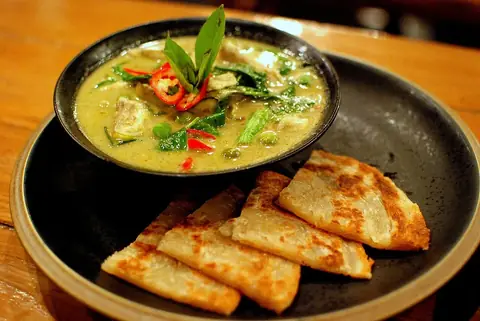
Thai green curry (kaeng khiao wan) is a coconut-milk curry made with a paste of fresh green chillies, lemongrass, galangal, makrut lime and shrimp paste, cooked with meat or fish balls, small Thai aubergines and sweet basil. It comes from central Thailand, is usually eaten with jasmine rice, and tends to be hotter than red curry.
- At a glance
- Green curry
- Coconut-milk curry with fresh green chilli paste, Thai aubergine and sweet basil.
- Pronunciation
- Say it like gaeng KHEE-ow WAHN · IPA /kɛ̄ːŋ kʰǐaw wǎːn/
- Also written as
- Thai green curry, gaeng keow wan, kaeng khiao wan kai (with chicken), แกงเขียวหวานไก่, green curry with fish balls (luk chin pla), khanom chin kaeng khiao wan (with rice noodles), green curry tofu
What’s in it
Core ingredients
- green curry paste: fresh green chillies, lemongrass, galangal, makrut lime zest, coriander root, shallot, garlic, cumin and coriander seed, white pepper, shrimp paste (kapi)
- coconut milk
- chicken, beef, pork or fish balls
- Thai aubergine and pea aubergine
- Thai sweet basil (horapha)
- makrut lime leaves
- fish sauce
- palm sugar
Often added
- prawns or mixed seafood
- bamboo shoots
- sliced red chilli
- tofu and soy sauce (vegetarian versions)
- jasmine rice
- khanom chin (fermented rice noodles)
- roti flatbread
Allergens
| Allergen | How likely |
|---|---|
| Fish | Typically contains |
| Shellfish | Typically contains |
| Soy | Sometimes contains |
| Gluten | Sometimes contains |
| Eggs | Sometimes contains |
| Dairy | Sometimes contains |
| Molluscs | Rarely contains |
| Peanuts | Rarely contains |
| Tree nuts | Rarely contains |
| Sesame | Rarely contains |
| Diet | Suitable? |
|---|---|
| Vegetarian | Depends — The usual paste contains shrimp paste and the curry is seasoned with fish sauce. Vegetarian (jay) versions use a paste without shrimp and soy sauce instead; ask for both. |
| Vegan | Depends — Same as vegetarian: coconut milk is plant-based, so a jay version with tofu and vegetables is usually vegan. Roti, if served, is often made with egg, milk or ghee. |
| Pescatarian | Depends — Chicken is the default; prawn, fish-ball or seafood versions are common, and the paste already contains shrimp. |
| Halal | Depends — Chicken and beef versions contain no pork, but most stalls and restaurants aren't certified; halal green curry is easy to find in southern Thailand and at Muslim-run restaurants. |
| Kosher | No |
| Gluten-free | Usually — Curry paste, coconut milk and fish sauce are normally wheat-free, but roti flatbread, served with it in some restaurants, is wheat, and soy or oyster sauce may be added, especially in vegetarian versions. |
Allergen and calorie details are AI estimates based on the menu and typical recipes. They can be incomplete — if you have a serious allergy, always check with the staff.
What goes into green curry
The colour comes from the paste: fresh green bird's eye chillies pounded with lemongrass, galangal, makrut lime zest, coriander root, shallots, garlic, toasted cumin and coriander seeds, white pepper and kapi, a fermented shrimp paste. The paste is fried in thick coconut cream until fragrant, then thinned with more coconut milk and simmered with meat or fish balls, crunchy Thai aubergines, tiny pea aubergines and makrut lime leaves. Fish sauce and a little palm sugar season it, and Thai sweet basil goes in at the end.
Khiao wan means "sweet green". The "sweet" describes the soft, pale shade of green the coconut milk gives the curry, not the taste. Green curry is thought to have taken its present form in the early 20th century.
How to order it
| Phrase | Romanization | Meaning |
|---|---|---|
| ขอแกงเขียวหวานไก่หนึ่งที่ครับ | Kho kaeng khiao wan kai nueng thi khrap. | One green curry with chicken, please. (Women say kha instead of khrap.) |
| ไม่เผ็ดมากครับ | Mai phet mak khrap. | Not too spicy, please. |
| พริกแกงมีกะปิไหมครับ | Phrik kaeng mi kapi mai khrap? | Does the curry paste contain shrimp paste? |
Not to be confused with
- Red curry (kaeng phet) — Made with a paste of dried red chillies; similar coconut base, usually a little milder and deeper in flavour.
- Massaman curry — A mild, sweet curry with dry spices, potatoes and peanuts, of Persian and Muslim influence.
- Panang curry — A thick, rich red curry, often with ground peanuts in the paste, served with little sauce.
Frequently asked questions
Is Thai green curry very spicy?
It can be. Green curry is made with fresh green chillies and tends to be hotter than red curry, though the coconut milk softens it. Restaurants catering to visitors usually tone it down. To ask for less heat, say "mai phet mak" (not too spicy) when ordering.
Is green curry vegetarian?
Not normally. Even a vegetable or tofu green curry is usually made with a paste containing shrimp paste and seasoned with fish sauce. Vegetarian (jay) restaurants and some tourist-area kitchens make a version with a shrimp-free paste and soy sauce. Ask about both the paste and the fish sauce.
Does green curry contain nuts?
Not usually: peanuts are more typical of massaman and panang curries. Green curry is built on coconut milk, though. Coconut isn't on the EU's list of allergenic nuts or on the US FDA's current (2025) list of tree nuts, but some people are allergic to it, so avoid it if you react. Kitchens that also make peanut curries share equipment.
How do you pronounce kaeng khiao wan?
Say gaeng KHEE-ow WAHN: in IPA, [kɛ̄ːŋ kʰǐaw wǎːn]. The k in kaeng is unaspirated, closer to a g, while kh is a breathy k. Khiao and wan both have a rising tone. Saying "green curry" in English is also understood in most restaurants.