Dish guides
What is salmorejo?
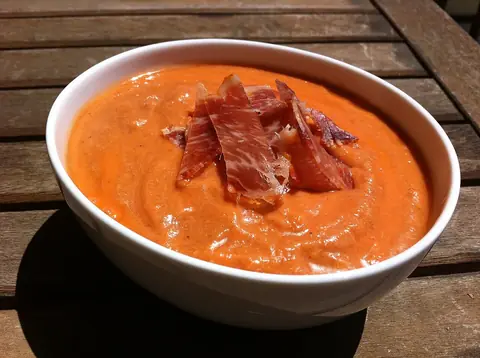
Salmorejo is a cold, thick purée of ripe tomatoes, bread, garlic and olive oil from Córdoba in Andalusia, usually topped with chopped hard-boiled egg and cured ham. It's thicker and smoother than gazpacho, eaten with a spoon from a bowl. Look for it among the entrantes (starters) or sopas, especially in summer.
- At a glance
- Salmorejo
- A thick, cold Andalusian cream of tomato, bread, garlic and olive oil.
- Pronunciation
- Say it like sahl-moh-REH-hoh · IPA /salmoˈɾexo/
- Also written as
- salmorejo cordobés, salmorejo con jamón, salmorejo tradicional, salmorejo con picatostes
What’s in it
Core ingredients
- ripe tomatoes
- white bread
- extra virgin olive oil
- garlic
- salt
Often added
- chopped hard-boiled egg on top
- diced jamón (cured ham) on top
- a splash of vinegar
- tuna on top
- picatostes (fried bread croutons)
Allergens
| Allergen | How likely |
|---|---|
| Gluten | Typically contains |
| Eggs | Often contains |
| Sulphites | Sometimes contains |
| Fish | Rarely contains |
| Dairy | Rarely contains |
| Peanuts | Rarely contains |
| Tree nuts | Rarely contains |
| Shellfish | Rarely contains |
| Soy | Rarely contains |
| Sesame | Rarely contains |
| Diet | Suitable? |
|---|---|
| Vegetarian | Depends — The cream itself is vegetarian, but it's usually topped with jamón; ask for it without ham (sin jamón). |
| Vegan | Depends — Without the egg and ham topping, the cream of tomato, bread, garlic and oil is plant-based; ask for it sin huevo y sin jamón. |
| Pescatarian | Depends — Fits if it's served without the ham topping. |
| Halal | Depends — The topping is usually jamón (pork); ask for it without ham (sin jamón). |
| Kosher | Depends — Ask for it without the jamón topping; even then, restaurants in Spain are rarely kosher-certified. |
| Gluten-free | No |
Allergen and calorie details are AI estimates based on the menu and typical recipes. They can be incomplete — if you have a serious allergy, always check with the staff.
Tomato, bread and a lot of olive oil
Salmorejo is made by blending ripe, peeled tomatoes with day-old white bread, raw garlic and salt, then slowly adding extra virgin olive oil until the mixture turns thick, glossy and orange-pink. The bread gives it body: in Córdoba the traditional choice is a dense loaf called pan de telera. Some cooks add a splash of vinegar; purists don't.
It's served chilled in a bowl or shallow dish, finished with chopped hard-boiled egg, small cubes of jamón and a thread of olive oil. Some bars add tuna or crunchy fried bread. The texture should be like a thick cream that holds a spoon, not like a soup.
Typical price
Median price 5 EUR
Typical range 4–10 EUR.
Median of 22 menus, 2025-04 – 2026-04. Basis: Spanish-language menus scanned with MenuGuide.
How to order it
| Phrase | Meaning |
|---|---|
| Un salmorejo, por favor. | A salmorejo, please. |
| ¿Me lo pone sin jamón, por favor? | Could I have it without the ham, please? |
| ¿Lleva pan? Soy celíaco. | Does it contain bread? I'm coeliac. |
Not to be confused with
- Gazpacho — Thinner and drinkable, with cucumber and green pepper; salmorejo is mostly tomato, bread and oil.
- Porra antequerana — A close cousin from Antequera, even thicker and often topped with tuna and egg.
- Ajoblanco — A white cold soup of almonds, bread, garlic and oil, often served with grapes; contains tree nuts.
Frequently asked questions
What's the difference between salmorejo and gazpacho?
Both are cold Andalusian tomato dishes, but salmorejo is much thicker and simpler: mainly tomato, bread, garlic and olive oil, eaten with a spoon and topped with egg and ham. Gazpacho is thinner and lighter, with cucumber, green pepper and vinegar, and is often served in a glass to drink.
Is salmorejo gluten free?
No, not normally. Bread is one of the main ingredients and gives salmorejo its thick texture, so it typically contains gluten. A few restaurants make it with gluten-free bread and mark it sin gluten. If you're coeliac, ask before ordering: ¿Lleva pan? Soy celíaco.
Is salmorejo vegetarian?
The cream itself is vegetarian, but it's traditionally topped with diced jamón, so the dish as served usually isn't. Ask for it without ham: sin jamón, por favor. Without the hard-boiled egg as well, the base of tomato, bread, garlic and olive oil is also vegan.
How do you pronounce salmorejo?
Say sahl-moh-REH-hoh, stressing the third syllable. The j is a throaty sound like the ch in Scottish loch, and the r is a single tap. In IPA it's [salmoˈɾexo]. In parts of Andalusia the j is softened to a light h, so it can sound like sahl-moh-REH-oh.