Dish guides
What is jamón ibérico?
Jamón ibérico is dry-cured ham from Spain's native Iberian pig breed, sliced paper-thin and eaten at room temperature. Its quality grade, from cebo (grain-fed) to 100% ibérico de bellota (acorn-fed, purebred), drives the price. On menus it appears under embutidos, ibéricos or raciones, sold by the ración, media ración or by weight.
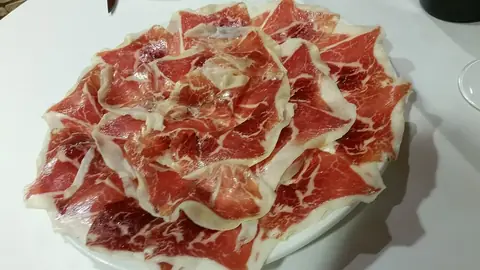
- At a glance
- Jamón ibérico
- Dry-cured ham from Iberian pigs, graded by breed purity and diet.
- Pronunciation
- Say it like hah-MOHN ee-BEH-ree-koh · IPA /xaˈmon iˈβeɾiko/
- Also written as
- jamón ibérico de bellota, jamón de bellota, jamón ibérico de cebo, jamón ibérico de cebo de campo, pata negra, ración de jamón ibérico, plato de jamón ibérico, Iberian ham
What’s in it
Core ingredients
- hind leg of an Iberian pig
- sea salt
- months to years of air-curing
Often added
- nitrites or nitrates (curing salts)
- bread, picos or pan con tomate served alongside
- olive oil drizzle
Allergens
| Allergen | How likely |
|---|---|
| Gluten | Rarely contains |
| Dairy | Rarely contains |
| Eggs | Rarely contains |
| Peanuts | Rarely contains |
| Tree nuts | Rarely contains |
| Shellfish | Rarely contains |
| Fish | Rarely contains |
| Soy | Rarely contains |
| Sesame | Rarely contains |
| Diet | Suitable? |
|---|---|
| Vegetarian | No |
| Vegan | No |
| Pescatarian | No |
| Halal | No |
| Kosher | No |
| Gluten-free | Usually |
Allergen and calorie details are AI estimates based on the menu and typical recipes. They can be incomplete — if you have a serious allergy, always check with the staff.
The four grades and their label colours
Since 2014, Spain's quality standard for Iberian products (Real Decreto 4/2014) sets four sales names for ibérico ham, each with a coloured tag on the leg:
- Black: de bellota 100% ibérico, from purebred Iberian pigs fattened on acorns (bellotas) in the dehesa, the oak pastureland of western Spain.
- Red: de bellota ibérico, acorn-fed but from crossbred pigs.
- Green: de cebo de campo ibérico, raised outdoors, with some access to pasture, but fed mainly on grain.
- White: de cebo ibérico, grain-fed on farms.
Labels also state the share of Iberian breed. Pata negra ("black hoof") is a popular nickname, and under the same standard the term may only be used on labels for 100% ibérico de bellota. Hams labelled serrano come from white pigs and aren't ibérico at all.
How to order it
| Phrase | Meaning |
|---|---|
| Una media ración de jamón ibérico, por favor. | A half portion of Iberian ham, please. |
| ¿Es de bellota o de cebo? | Is it acorn-fed (bellota) or grain-fed (cebo)? |
| ¿Está cortado a cuchillo? | Is it hand-carved? |
Not to be confused with
- Jamón serrano — Cured ham from white (non-Iberian) pigs; milder and usually much cheaper.
- Paleta ibérica — The cured front leg (shoulder) of the same pig; smaller and a little less expensive than jamón.
- Secreto ibérico — A fresh cut of Iberian pork, grilled and served hot; not cured ham.
- Prosciutto — Italian cured ham, usually from white pigs, softer and sweeter in style.
Frequently asked questions
What's the difference between jamón ibérico and jamón serrano?
Jamón ibérico comes from the Iberian pig breed, usually black-hoofed, and is graded by breed purity and diet, with acorn-fed bellota at the top. Jamón serrano comes from white pig breeds and is cured in a similar way, but is milder and leaner. On a menu, ibérico costs noticeably more than serrano.
Is jamón ibérico raw?
It isn't cooked, but it isn't fresh raw meat either: the ham is salted, then air-dried and cured. Spain's standard requires at least 600 days of curing, and 730 days for legs of 7 kg or more. That long curing is why it's eaten as it is, without cooking. Pregnant travellers are commonly advised to ask their doctor about cured meats.
Is jamón ibérico gluten free?
The ham itself is usually just pork and salt, sometimes with curing salts, so it doesn't normally contain gluten. The gluten comes from what's served with it: bread, picos (small breadsticks) or pan con tomate. If you need to avoid gluten, ask for the ham without bread (sin pan) or for gluten-free bread.
What does pata negra mean?
Pata negra means black hoof, as many Iberian pigs have dark hooves. People use it loosely for any top-quality ham, but under Spain's quality standard the term may only appear on the label of 100% ibérico de bellota, the black-tag grade. On a menu, look for the words bellota and 100% ibérico rather than the nickname.