Dish guides
What is goulash (gulyás)?
Gulyás
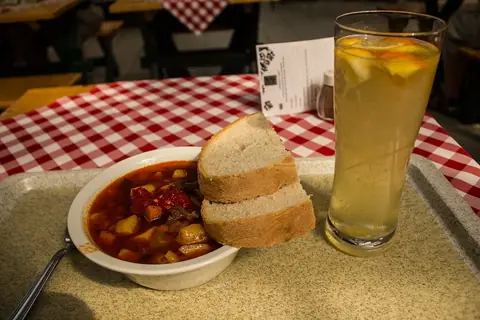
Goulash means two different dishes depending on where you are. In Hungary, gulyás is a paprika-red beef soup with potatoes, carrots and caraway, eaten as a hearty main. In Czechia, Austria and Germany, guláš or Gulasch is a thick beef and onion stew in paprika gravy, served with bread dumplings or a roll.
- At a glance
- Goulash (gulyás)
- Hungarian paprika beef soup; elsewhere in Central Europe, a thick paprika stew.
- Pronunciation
- Say it like GOO-yahsh · IPA /ˈɡujaːʃ/
- Also written as
- gulyásleves, goulash soup, guláš, hovězí guláš, gulášová polévka, Gulasch, Rindsgulasch, Gulaschsuppe, beef goulash
What’s in it
Core ingredients
- beef (shin or shoulder)
- onions
- sweet paprika
- caraway seeds
- garlic
- lard or oil
Often added
- potatoes, carrots and parsley root (Hungarian soup)
- celeriac or celery
- tomato and green pepper
- csipetke (pinched egg noodles)
- flour or bread to thicken (stew)
- marjoram
- bread dumplings (knedlíky) or a roll on the side
- hot paprika or chilli
Allergens
| Allergen | How likely |
|---|---|
| Gluten | Often contains |
| Celery | Often contains |
| Eggs | Often contains |
| Dairy | Often contains |
| Sulphites | Sometimes contains |
| Mustard | Rarely contains |
| Peanuts | Rarely contains |
| Tree nuts | Rarely contains |
| Shellfish | Rarely contains |
| Fish | Rarely contains |
| Soy | Rarely contains |
| Sesame | Rarely contains |
| Diet | Suitable? |
|---|---|
| Vegetarian | No |
| Vegan | No |
| Pescatarian | No |
| Halal | Depends — Hungarian gulyás is made with beef, but it's often cooked in pork lard, and some Czech and German versions use pork. |
| Kosher | No |
| Gluten-free | Depends — A Hungarian soup without csipetke can be gluten-free; Czech and Austrian stews are usually thickened with flour or bread and served with bread dumplings or a roll. |
Allergen and calorie details are AI estimates based on the menu and typical recipes. They can be incomplete — if you have a serious allergy, always check with the staff.
In Hungary it's a soup
The name comes from gulyás, a cattle herder on the Hungarian plains, and the dish began as the herders' one-pot meal. Today's Hungarian gulyásleves (goulash soup) is made by softening onions in lard, stirring in sweet paprika off the heat so it doesn't burn, then adding cubed beef, garlic and caraway. Potatoes, carrots, parsley root and often celeriac go in later, with tomato and green pepper. In the countryside, small pinched egg noodles called csipetke are dropped in at the end.
It arrives as a deep bowl of brick-red broth with tender meat and vegetables, and Hungarians treat it as a main course, not a starter. It's usually mild; hot paprika or fresh chilli is served on the side if you want heat.
In Czechia, Austria and Germany it's a stew
Outside Hungary, "goulash" usually means a stew much closer to the Hungarian pörkölt: beef braised slowly with a large amount of onion and paprika until the sauce turns thick and glossy, often seasoned with marjoram and caraway and sometimes thickened with flour or bread.
- Czechia: hovězí guláš comes with sliced bread dumplings (knedlíky), which contain wheat and often egg and milk, and is often topped with raw onion rings. Gulášová polévka is the soup version, closer to the Hungarian dish.
- Austria: Rindsgulasch or Saftgulasch comes with a bread roll; Fiakergulasch adds a fried egg, a sausage and a gherkin.
- Germany: Gulasch is often served with noodles, potatoes or dumplings, and Gulaschsuppe is a popular soup.
Typical price
Median price 290 CZK
Typical range 170–380 CZK.
Median of 25 menus, 2025-04 – 2026-05. Basis: Czech- and English-language menus priced in Czech koruna, scanned with MenuGuide; goulash soup and stew.
How to order it
| Phrase | Meaning |
|---|---|
| Egy gulyáslevest kérnék. | I'd like a goulash soup. |
| Csípős? | Is it spicy? |
| Van benne zeller? | Is there celery in it? |
Not to be confused with
- Pörkölt — Hungarian thick paprika stew without potatoes, the dish most of Europe calls goulash; often served with nokedli dumplings.
- Paprikás — Pörkölt finished with sour cream, usually made with chicken (csirkepaprikás): adds dairy.
- Gulas (Spain) — Imitation baby eels made from fish surimi, usually fried with garlic; nothing to do with goulash.
Frequently asked questions
Is goulash a soup or a stew?
Both, depending on the country. In Hungary, gulyás is a soup of beef, paprika, potatoes and vegetables, eaten as a main course. In Czechia, Austria and Germany, guláš or Gulasch is a thick paprika stew served with dumplings or bread. The Hungarian equivalent of that stew is called pörkölt.
Is goulash spicy?
Usually not very. Hungarian gulyás and Central European goulash get their red colour from sweet paprika, which is mild and fragrant. Some cooks add hot paprika or chilli, and Hungarian restaurants often put a hot paprika paste or fresh chilli on the table so you can add heat. Ask "Csípős?" in Hungary if you want to be sure.
What are gulas on a Spanish menu?
Gulas are imitation baby eels, made from fish surimi and shaped into thin grey strands. They're usually cooked al ajillo, sizzling with olive oil, garlic and chilli, and served as a tapa. Despite the similar name, they have nothing to do with Hungarian goulash, and they contain fish.
How do you pronounce gulyás?
Say GOO-yahsh, with the stress on the first syllable: in IPA, [ˈɡujaːʃ]. In Hungarian, "ly" sounds like an English "y" and "s" sounds like "sh". The soup is gulyásleves (GOO-yahsh-leh-vesh). In Czech, guláš is said GOO-lahsh. Both languages always stress the first syllable of a word.