Dish guides
What are pierogi?
Pierogi are Polish half-moon dumplings made from a thin wheat dough and filled with potato and curd cheese, meat, sauerkraut and mushrooms, or fruit. They're boiled, sometimes pan-fried afterwards, and served with fried onion, butter, sour cream or crispy bits of pork fat. The most common kind, pierogi ruskie, is filled with potato, twaróg cheese and onion.
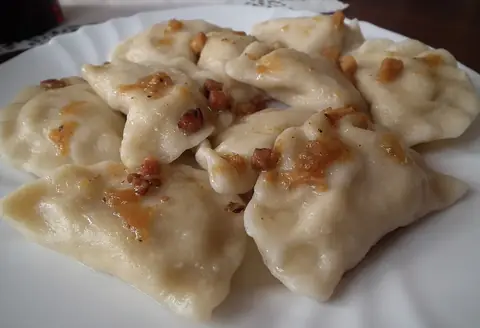
- At a glance
- Pierogi
- Polish half-moon dumplings with savoury or sweet fillings, boiled or fried.
- Pronunciation
- Say it like pyeh-ROH-gee · IPA /pʲɛˈrɔɡʲi/
- Also written as
- pierogi ruskie, pierogi z mięsem, pierogi z kapustą i grzybami, pierogi z serem, pierogi z jagodami, pierogies, perogies
What’s in it
Core ingredients
- wheat-flour dough
- a filling: potato and curd cheese (ruskie), meat, sauerkraut and mushrooms, sweet cheese or fruit
- onion
Often added
- egg or sour cream in the dough
- fried onion on top
- skwarki (crispy pork fat)
- butter
- sour cream (śmietana)
- sugar and cream with fruit pierogi
Allergens
| Allergen | How likely |
|---|---|
| Gluten | Typically contains |
| Dairy | Often contains |
| Eggs | Often contains |
| Celery | Rarely contains |
| Mustard | Rarely contains |
| Peanuts | Rarely contains |
| Tree nuts | Rarely contains |
| Shellfish | Rarely contains |
| Fish | Rarely contains |
| Soy | Rarely contains |
| Sesame | Rarely contains |
| Diet | Suitable? |
|---|---|
| Vegetarian | Depends — Ruskie, cabbage-and-mushroom and fruit pierogi have meat-free fillings, but they're often topped with skwarki (pork fat) or fried in lard; ask for fried onion instead. |
| Vegan | Depends — Rare: the dough often contains egg and toppings use butter or sour cream. Some cabbage-and-mushroom pierogi are vegan; ask. |
| Pescatarian | Depends — As for vegetarians: check the topping and frying fat. A few places also offer fish-filled pierogi. |
| Halal | Depends — Meat fillings are often pork or a pork and beef mix, and pork-fat toppings are common, even on meat-free fillings. |
| Kosher | No |
| Gluten-free | No |
Allergen and calorie details are AI estimates based on the menu and typical recipes. They can be incomplete — if you have a serious allergy, always check with the staff.
The fillings, decoded
Polish menus name pierogi by their filling, so the words after pierogi tell you what's inside:
- ruskie: potato, twaróg (a fresh curd cheese) and fried onion. The most popular kind, and despite the name, not Russian: it refers to the historical region of Red Ruthenia.
- z mięsem: minced cooked meat, often pork or a mix with beef.
- z kapustą i grzybami: sauerkraut and wild mushrooms, the classic for Christmas Eve.
- ze szpinakiem: spinach, often with cheese or garlic.
- z serem or na słodko: sweet curd cheese, served with sugar or cream.
- z jagodami / z owocami: blueberries or other fruit, a summer dessert or sweet main, with sour cream and sugar.
On the plate
Pierogi are boiled first, which leaves them soft and slightly chewy. Menus may offer them gotowane (boiled) or smażone (pan-fried after boiling, with crisp golden spots). Savoury ones are usually topped with fried onion and either butter or skwarki, small cubes of crispy pork fat, with sour cream on the side. Menus often state how many pieces come in a portion (szt. means pieces), and a full portion is a filling main course.
You'll find them everywhere from a pierogarnia (a restaurant specialising in pierogi) to a bar mleczny, the inexpensive canteen-style "milk bar", as well as in upmarket restaurants with fillings like duck or veal.
Allergen notes
The dough is wheat flour and water, and many cooks add egg, oil or sour cream to make it softer, so gluten is a given and egg is common. Dairy comes from the twaróg in ruskie and sweet cheese pierogi, from butter and from the sour cream served alongside. Even meat-free fillings often get a pork-fat topping. For other Central European classics, see goulash and Wiener Schnitzel.
Typical price
Median price 42 PLN
Typical range 24.5–59 PLN.
Median of 20 menus, 2025-05 – 2026-05. Basis: Polish-language menus scanned with MenuGuide.
How to order it
| Phrase | Meaning |
|---|---|
| Poproszę pierogi ruskie. | Ruskie pierogi, please. |
| Czy są podawane ze skwarkami? | Do they come with pork crackling on top? |
| Czy w cieście są jajka? | Is there egg in the dough? |
Not to be confused with
- Varenyky (Ukraine) — The Ukrainian name for very similar boiled dumplings with the same kinds of fillings.
- Pelmeni — Small Russian meat dumplings, often served in broth or with sour cream.
- Gyoza — Japanese pan-fried dumplings with a thinner wrapper and a pork, cabbage and garlic filling.
Frequently asked questions
What are pierogi ruskie?
Pierogi ruskie are dumplings filled with mashed potato, twaróg (Polish curd cheese) and fried onion, usually topped with more onion or crispy pork fat. They're the most common pierogi in Poland. The name doesn't mean Russian: it refers to Red Ruthenia, a historical region now split between Poland and Ukraine.
Are pierogi vegetarian?
Some fillings are. Ruskie, cabbage and mushroom, spinach, cheese and fruit pierogi contain no meat, but savoury ones are often topped with skwarki (crispy pork fat) or fried in lard. Ask for them with fried onion only, "tylko z cebulką", and check whether they're fried in butter or oil.
Are pierogi boiled or fried?
Always boiled first. They can be served straight from the water, soft and smooth, or pan-fried afterwards until golden and crisp in places. Menus often offer both: gotowane means boiled and smażone means fried. Baked pierogi exist too, but they're less common in restaurants.
How do you pronounce pierogi?
Say pyeh-ROH-gee, with a hard "g" as in "go" and the stress on the middle syllable: in IPA, [pʲɛˈrɔɡʲi]. Pierogi is already plural in Polish; one dumpling is a pieróg (PYEH-rook). North American spellings such as "perogies" refer to the same dish.