Dish guides
What is cacio e pepe?
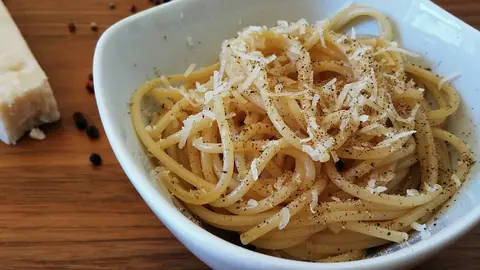
Cacio e pepe ("cheese and pepper") is a Roman pasta made with just pecorino romano, freshly ground black pepper and starchy pasta water, which melt into a creamy sauce. There's no meat, egg or cream. It's listed among the primi, usually as tonnarelli or spaghetti cacio e pepe.
- At a glance
- Cacio e pepe
- Roman pasta tossed with pecorino romano, black pepper and pasta water.
- Pronunciation
- Say it like KAH-choh eh PEH-peh · IPA /ˈkaːtʃo e pˈpeːpe/
- Also written as
- tonnarelli cacio e pepe, spaghetti cacio e pepe, pici cacio e pepe, pasta cacio e pepe
What’s in it
Core ingredients
- pasta (tonnarelli or spaghetti)
- pecorino romano
- black pepper
- starchy pasta cooking water
Often added
- a little parmigiano reggiano
- butter or olive oil (some modern kitchens)
- pici instead of tonnarelli (Tuscany)
- cream (some versions outside Italy)
Allergens
| Allergen | How likely |
|---|---|
| Dairy | Typically contains |
| Gluten | Typically contains |
| Eggs | Often contains |
| Peanuts | Rarely contains |
| Tree nuts | Rarely contains |
| Shellfish | Rarely contains |
| Fish | Rarely contains |
| Soy | Rarely contains |
| Sesame | Rarely contains |
| Diet | Suitable? |
|---|---|
| Vegetarian | Depends — There's no meat, but pecorino romano is made with animal rennet, which strict vegetarians avoid. |
| Vegan | No |
| Pescatarian | Usually |
| Halal | Depends — No meat or alcohol; some halal diners avoid cheese made with animal rennet, as pecorino romano is. |
| Kosher | Depends — Only with kosher-certified cheese, which ordinary Italian restaurants don't use. |
| Gluten-free | Depends — Only when it's made with gluten-free pasta (pasta senza glutine), which some restaurants offer on request. |
Allergen and calorie details are AI estimates based on the menu and typical recipes. They can be incomplete — if you have a serious allergy, always check with the staff.
Three ingredients and a technique
Cacio is the word for cheese in several central Italian dialects, and here it means pecorino romano, a hard, salty sheep's-milk cheese. The cook toasts or grinds plenty of black pepper, grates the pecorino very finely and mixes it with a ladle of the starchy water the pasta cooked in. The drained pasta is then tossed with this paste until the cheese melts into a smooth, pale cream that clings to every strand.
It sounds simple, but the sauce is easy to ruin. If the pan is too hot, the pecorino seizes into rubbery lumps. A good cacio e pepe is glossy and loose, never stringy. The problem is famous enough that a team of physicists won a 2025 Ig Nobel Prize for working out how to keep the sauce from clumping.
Shepherds' food, according to the story
A common story says the dish began with shepherds in the hills of Lazio and neighbouring regions, who carried dried pasta, aged pecorino and pepper because they kept for weeks. It's a nice story but hard to prove, and pepper was expensive for a long time. Today cacio e pepe belongs to Rome's four classic pastas, together with gricia, carbonara and amatriciana.
Typical price
Median price 13.5 EUR
Typical range 8.5–18 EUR.
Median of 28 menus, 2025-05 – 2026-04. Basis: Italian-language menus scanned with MenuGuide.
How to order it
| Phrase | Meaning |
|---|---|
| Vorrei i tonnarelli cacio e pepe, per favore. | I'd like the tonnarelli cacio e pepe, please. |
| La pasta è all'uovo? | Is the pasta made with egg? |
| Avete la pasta senza glutine? | Do you have gluten-free pasta? |
Not to be confused with
Frequently asked questions
Is cacio e pepe vegetarian?
It contains no meat or fish, so most vegetarians eat it. Strict vegetarians should know that pecorino romano is made with animal rennet, an enzyme from the stomach of young animals, as are most traditional Italian hard cheeses. If that matters to you, ask about the cheese, although few restaurants will have a rennet-free alternative.
Does cacio e pepe have butter or cream?
The Roman original has neither: the creaminess comes from pecorino melted with starchy pasta water. Some restaurants add a knob of butter or a little olive oil to make the sauce easier to emulsify, and versions outside Italy sometimes use cream. If you avoid dairy, the dish isn't an option either way, because the cheese is the sauce.
Does cacio e pepe contain egg?
The sauce doesn't, but the pasta often does. Tonnarelli, the fresh pasta Roman trattorie often use for cacio e pepe, are usually made with egg, while dried spaghetti normally isn't. If you're allergic to eggs, ask "La pasta è all'uovo?" (Is the pasta made with egg?) and order it with dried spaghetti if needed.
How do you pronounce cacio e pepe?
Say KAH-choh eh PEH-peh. The c in cacio sounds like the ch in church, and the i is silent. In Italian the p of pepe is slightly doubled after e, so it sounds like eh-PPEH-peh. In IPA it's [ˈkaːtʃo e pˈpeːpe]. Don't pronounce it like "cash-ee-oh".
What's the difference between cacio e pepe and carbonara?
Cacio e pepe is only pecorino, black pepper and pasta water. Carbonara starts from the same cheese and pepper but adds egg yolks and crisp guanciale, so it's richer, yellower and not vegetarian. Gricia sits in between: guanciale, pecorino and pepper, with no egg.