Dish guides
What is amatriciana?
Amatriciana is a pasta sauce of tomato, guanciale (cured pork cheek) and pecorino cheese, seasoned with black pepper or a little chilli. It comes from the mountain town of Amatrice, north-east of Rome, and is one of the Roman classics. On menus it appears as bucatini, spaghetti or rigatoni all'amatriciana.
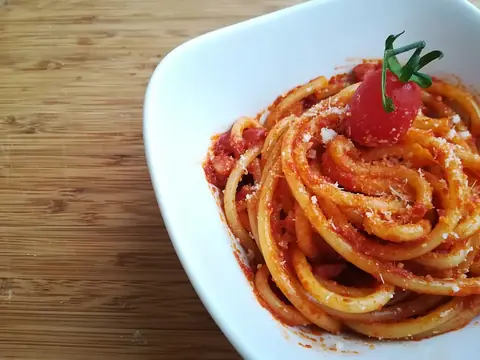
- At a glance
- Amatriciana
- Pasta with tomato, guanciale, pecorino and black pepper or chilli.
- Pronunciation
- Say it like ah-mah-tree-CHAH-nah · IPA /amatriˈtʃaːna/
- Also written as
- bucatini all'amatriciana, spaghetti all'amatriciana, rigatoni all'amatriciana, mezze maniche all'amatriciana, penne all'amatriciana, matriciana
What’s in it
Core ingredients
- pasta (bucatini, spaghetti or rigatoni)
- guanciale (cured pork cheek)
- tomatoes (peeled or passata)
- pecorino romano or pecorino di Amatrice
- black pepper or dried chilli
Often added
- dry white wine
- a little olive oil
- onion (common in Rome, rejected in Amatrice)
- pancetta instead of guanciale (outside Lazio)
Allergens
| Allergen | How likely |
|---|---|
| Gluten | Typically contains |
| Dairy | Typically contains |
| Sulphites | Often contains |
| Eggs | Rarely contains |
| Peanuts | Rarely contains |
| Tree nuts | Rarely contains |
| Shellfish | Rarely contains |
| Fish | Rarely contains |
| Soy | Rarely contains |
| Sesame | Rarely contains |
| Diet | Suitable? |
|---|---|
| Vegetarian | No |
| Vegan | No |
| Pescatarian | No |
| Halal | No |
| Kosher | No |
| Gluten-free | Depends — Only when it's made with gluten-free pasta (pasta senza glutine), which some restaurants offer on request. |
Allergen and calorie details are AI estimates based on the menu and typical recipes. They can be incomplete — if you have a serious allergy, always check with the staff.
What goes into amatriciana
Strips of guanciale are fried slowly until the fat runs and the edges crisp. Many cooks splash in dry white wine, then add tomatoes and simmer briefly until the sauce thickens. The pasta is tossed in the sauce and finished with grated pecorino, either pecorino romano or pecorino di Amatrice, and black pepper or a pinch of dried chilli.
Amatrice is strict about what doesn't belong: no garlic, no onion and no pancetta. Many Roman trattorie add onion anyway, which is one of Italy's favourite kitchen arguments. The town itself serves it with spaghetti, while in Rome bucatini, thick spaghetti with a hole through the middle, are the classic choice. In 2020 the EU registered amatriciana tradizionale as a TSG, its label for protected traditional recipes.
From gricia to amatriciana
Amatriciana grew out of gricia, the older white version made with only guanciale, pecorino and pepper. Tomato was added later, and the first written recipe under the name spaghetti all'amatriciana dates from 1914, in a cookbook by Amedeo Pettini. Many of Rome's 19th-century innkeepers came from the Amatrice area, which helps explain how the dish became a staple of the city's trattorie. Romans often shorten the name to matriciana.
Typical price
Median price 13 EUR
Typical range 10–14.5 EUR.
Median of 37 menus, 2025-05 – 2026-04. Basis: Italian-language menus scanned with MenuGuide.
How to order it
| Phrase | Meaning |
|---|---|
| Vorrei i bucatini all'amatriciana, per favore. | I'd like the bucatini amatriciana, please. |
| È piccante? | Is it spicy? |
| C'è maiale? Non mangio carne di maiale. | Is there pork in it? I don't eat pork. |
Not to be confused with
Frequently asked questions
Does amatriciana have onion or garlic?
The recipe from Amatrice has neither: only guanciale, tomato, pecorino, pepper or chilli, and often white wine. Many restaurants in Rome do add onion, and some kitchens outside Italy add garlic. Neither is wrong for your health, but if you want the traditional taste, ask "C'è la cipolla?" (Is there onion?) before ordering.
Is amatriciana spicy?
Usually only mildly. The traditional recipe uses a small piece of chilli (peperoncino), sometimes with black pepper, so most versions have only a gentle warmth. It's far less spicy than arrabbiata, whose name means "angry" because of its chilli. If you're sensitive to heat, ask "È piccante?" (Is it spicy?).
Is amatriciana gluten free?
Not normally, because it's served with wheat pasta. The sauce itself (guanciale, tomato, pecorino and pepper) doesn't usually contain gluten, so the dish can be gluten-free with gluten-free pasta, which some Italian restaurants offer. Ask whether the pasta is cooked in separate water if you need to avoid cross-contact.
How do you pronounce amatriciana?
Say ah-mah-tree-CHAH-nah, with the stress on the fourth syllable. The ci makes a ch sound, as in church, and the i after it isn't pronounced separately. In IPA it's [amatriˈtʃaːna]. On a menu, all'amatriciana is said ahl-lah-mah-tree-CHAH-nah, run together as one word.
What's the difference between amatriciana and arrabbiata?
Amatriciana is built on guanciale, cured pork cheek, and finished with pecorino cheese, so it's meaty and savoury. Arrabbiata is a meat-free tomato sauce with garlic and a lot of chilli, usually served with penne and often without cheese. If you don't eat pork, arrabbiata is the one to choose.