Dish guides
What is carbonara?
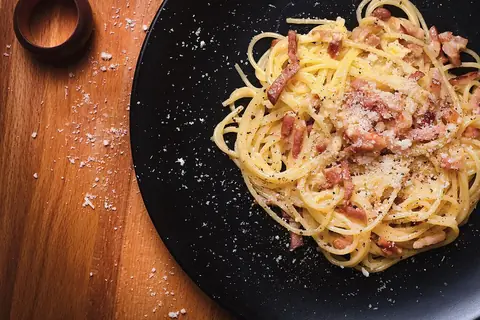
Carbonara is a Roman pasta dish made with egg yolks, guanciale (cured pork cheek), pecorino romano cheese and plenty of black pepper, tossed off the heat into a glossy sauce. In Italy it has no cream. You'll find it among the primi (pasta courses), usually as spaghetti, rigatoni or mezze maniche alla carbonara.
- At a glance
- Carbonara
- Roman pasta with egg, guanciale, pecorino romano and black pepper.
- Pronunciation
- Say it like kar-boh-NAH-rah · IPA /karboˈnaːra/
- Also written as
- spaghetti alla carbonara, rigatoni alla carbonara, mezze maniche alla carbonara, tonnarelli carbonara, pasta carbonara
What’s in it
Core ingredients
- pasta (spaghetti, rigatoni or mezze maniche)
- egg yolks or whole eggs
- guanciale (cured pork cheek)
- pecorino romano
- black pepper
Often added
- parmigiano reggiano mixed with the pecorino
- pancetta instead of guanciale
- cream (mostly outside Italy)
- garlic or onion (tourist-menu versions)
Allergens
| Allergen | How likely |
|---|---|
| Gluten | Typically contains |
| Eggs | Typically contains |
| Dairy | Typically contains |
| Peanuts | Rarely contains |
| Tree nuts | Rarely contains |
| Shellfish | Rarely contains |
| Fish | Rarely contains |
| Soy | Rarely contains |
| Sesame | Rarely contains |
| Diet | Suitable? |
|---|---|
| Vegetarian | No |
| Vegan | No |
| Pescatarian | No |
| Halal | No |
| Kosher | No |
| Gluten-free | Depends — Only when it's made with gluten-free pasta (pasta senza glutine), which some restaurants offer on request. |
Allergen and calorie details are AI estimates based on the menu and typical recipes. They can be incomplete — if you have a serious allergy, always check with the staff.
What goes into a Roman carbonara
The Roman version uses five ingredients. Guanciale is cut into strips and rendered until crisp. Egg yolks (some cooks add a whole egg) are beaten with grated pecorino romano and a lot of black pepper. The hot pasta is tossed with the guanciale and its fat, then taken off the heat and mixed with the egg and cheese. A splash of pasta water turns it into a creamy sauce that coats the pasta without scrambling.
The creaminess comes from egg and cheese, not cream. Many Roman cooks treat cream, garlic and onion as mistakes. Some kitchens mix parmigiano into the pecorino for a milder taste, and outside Rome you'll often see pancetta instead of guanciale.
Where carbonara comes from
Carbonara is younger than its reputation. The first known recipes were printed in the early 1950s, in a Chicago cookbook in 1952 and in the Italian magazine La Cucina Italiana in 1954, and its origin is still debated. One popular theory links it to the bacon and powdered egg that Allied troops brought to Italy in 1944. Another ties the name to the carbonari, charcoal burners of the Apennines. Neither theory is proven. It spread quickly in the following decades and is now a fixture of Roman trattorie, alongside its older relatives gricia and amatriciana.
Typical price
Median price 13.5 EUR
Typical range 10–18 EUR.
Median of 60 menus, 2025-05 – 2026-04. Basis: Italian-language menus scanned with MenuGuide.
How to order it
| Phrase | Meaning |
|---|---|
| Vorrei gli spaghetti alla carbonara, per favore. | I'd like the spaghetti carbonara, please. |
| C'è la panna? | Is there cream in it? |
| Avete la pasta senza glutine? | Do you have gluten-free pasta? |
Not to be confused with
- Gricia — Guanciale, pecorino and pepper like carbonara, but no egg.
- Amatriciana — Guanciale and pecorino with a tomato sauce; no egg.
- Cacio e pepe — Just pecorino, pepper and pasta water: no meat and no egg.
Frequently asked questions
Does carbonara have cream?
Traditional Italian carbonara has no cream: the silky sauce comes from egg yolks, pecorino and starchy pasta water. Cream is common in versions served outside Italy and in some tourist restaurants. If you want to check, look for the word panna in the menu description, or ask "C'è la panna?" (Is there cream in it?).
Are the eggs in carbonara raw?
They aren't fully raw, but they aren't fully cooked either. The eggs are thickened by the heat of the freshly drained pasta and the pan, off the flame, so the sauce stays creamy rather than scrambled. If you avoid undercooked eggs, for example during pregnancy, carbonara is worth skipping or asking about.
Is carbonara gluten free?
Not normally, because it's made with wheat pasta. Guanciale, eggs, pecorino and pepper don't usually contain gluten, so the dish can be gluten-free when it's made with gluten-free pasta. Some restaurants in Italy offer pasta senza glutine on request. Ask whether it's cooked in separate water if you need to avoid cross-contact.
How do you pronounce carbonara?
Say kar-boh-NAH-rah, with the stress on the third syllable and a long "ah" sound: in IPA, [karboˈnaːra]. The r is lightly tapped, as in most Italian words. On menus it usually appears as "spaghetti alla carbonara" (spah-GET-tee AHL-lah kar-boh-NAH-rah), meaning spaghetti in the carbonara style.
What's the difference between carbonara, gricia and amatriciana?
All three are Roman pastas built on guanciale and pecorino romano. Gricia stops there, with black pepper. Carbonara adds egg yolks for a creamy sauce. Amatriciana adds tomato instead of egg. Cacio e pepe, the fourth Roman classic, leaves out the meat entirely and uses only pecorino, pepper and pasta water.