Dish guides
What is saganaki?
Σαγανάκι · Saganáki
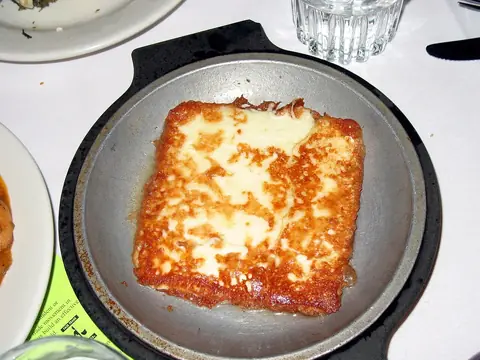
Saganaki usually means a slab of hard Greek cheese, dusted with flour and fried in a small pan until crisp outside and molten inside, served hot with lemon. The name comes from the pan, so menus also list shrimp or mussel saganaki, cooked in a spicy tomato sauce with feta. It's a meze for sharing.
- At a glance
- Saganaki
- Greek pan-fried cheese with lemon, or prawns or mussels cooked saganaki-style.
- Pronunciation
- Say it like sah-ghah-NAH-kee · IPA /saɣaˈnaci/
- Also written as
- saganaki cheese, τυρί σαγανάκι (tyrí saganáki), γαρίδες σαγανάκι (garídes saganáki), shrimp saganaki, μύδια σαγανάκι (mýdia saganáki), mussels saganaki, flaming saganaki
What’s in it
Core ingredients
- hard sheep's or mixed-milk cheese (graviera, kefalograviera, kasseri or kefalotyri)
- flour
- olive oil
- lemon
Often added
- black pepper or oregano
- egg wash before the flour
- honey and sesame seeds
- prawns or mussels in tomato sauce with feta (seafood saganaki)
- ouzo, brandy or wine
- bread for dipping
Allergens
| Allergen | How likely |
|---|---|
| Dairy | Typically contains |
| Gluten | Typically contains |
| Shellfish | Sometimes contains |
| Molluscs | Sometimes contains |
| Eggs | Sometimes contains |
| Sesame | Sometimes contains |
| Sulphites | Sometimes contains |
| Peanuts | Rarely contains |
| Tree nuts | Rarely contains |
| Fish | Rarely contains |
| Soy | Rarely contains |
| Diet | Suitable? |
|---|---|
| Vegetarian | Depends — Cheese saganaki has no meat or fish, but traditional Greek hard cheeses are usually made with animal rennet. Shrimp and mussel saganaki aren't vegetarian. |
| Vegan | No |
| Pescatarian | Usually |
| Halal | Depends — Traditional cheeses usually use animal rennet, and some versions are flambéed with brandy or cooked with ouzo or wine. |
| Kosher | Depends — Shrimp and mussel saganaki aren't kosher; cheese saganaki is kosher only with certified cheese from a kosher kitchen. |
| Gluten-free | Depends — Cheese saganaki is dusted with flour before frying. Shrimp and mussel saganaki usually aren't floured but come with bread. |
Allergen and calorie details are AI estimates based on the menu and typical recipes. They can be incomplete — if you have a serious allergy, always check with the staff.
What saganaki is
The word saganáki is the name of a small two-handled frying pan, and the dish is whatever is cooked in it. The best-known version is fried cheese: a thick slice of a firm cheese such as graviera, kefalograviera, kasseri or kefalotyri, sometimes dipped in egg, dusted with flour and fried in olive oil until golden. It's served straight from the pan with a wedge of lemon and eaten with bread, ideally while it's still hot and stretchy.
Regional cheeses change the taste: formaela in Arachova, vlahotiri in Metsovo, halloumi in Cyprus. Some tavernas finish it with honey and sesame seeds, which matters if you avoid sesame.
Shrimp and mussel saganaki
On a seafood menu, garídes saganáki (γαρίδες σαγανάκι) means prawns cooked in a spicy tomato sauce with crumbled feta, sometimes with a splash of ouzo or wine. Mýdia saganáki (μύδια σαγανάκι) is the same idea with mussels. These are saucy, not crisp, and come with bread for dipping. If you're allergic to crustaceans or molluscs, check which saganaki you're ordering.
How to order it
| Phrase | Romanization | Meaning |
|---|---|---|
| Ένα σαγανάκι, παρακαλώ. | Éna saganáki, parakaló. | One saganaki, please. |
| Είναι με τυρί ή με γαρίδες; | Eínai me tyrí í me garídes? | Is it with cheese or with prawns? |
| Έχει αλεύρι; | Échei alévri? | Does it have flour on it? |
Not to be confused with
- Halloumi — A Cypriot cheese usually grilled rather than floured and fried; sometimes used for saganaki in Cyprus.
- Bouyiourdi (μπουγιουρντί) — Feta baked in a clay dish with tomato, peppers and chilli; soft and saucy, not crisp.
- Feta me meli — Feta wrapped in filo pastry, fried or baked, with honey and sesame seeds.
Frequently asked questions
What cheese is used for saganaki?
Saganaki is usually made with a firm Greek cheese that holds its shape when fried, such as graviera, kefalograviera, kasseri or kefalotyri. Some places use feta or halloumi, and some regions use local cheeses like formaela or vlahotiri. Most are made from sheep's milk or a sheep and goat mix, so they're salty and tangy.
Is saganaki gluten free?
Cheese saganaki usually isn't, because the cheese is dusted with flour, and sometimes dipped in egg, before frying. Shrimp and mussel saganaki are normally cooked without flour, but they're served with bread. Ask "Έχει αλεύρι;" (Échei alévri? – Does it have flour on it?) if you need to avoid gluten.
Why is saganaki set on fire?
The flaming show is mostly a North American custom: the fried cheese is doused with brandy or ouzo and lit at the table, then put out with lemon juice while staff shout "Opa!". It reportedly started in Chicago's Greektown in 1968. In Greece, saganaki usually arrives simply fried with lemon, no flames.
How do you pronounce saganaki?
Say "sah-ghah-NAH-kee", stressing the third syllable, in IPA [saɣaˈnaci]. The Greek γ (g) between vowels is soft and breathy, closer to a gargled h than a hard g, and the k before i sounds slightly like "ky". In Greek it's written σαγανάκι.