Dish guides
What is horiatiki (Greek salad)?
Χωριάτικη σαλάτα · Choriátiki saláta
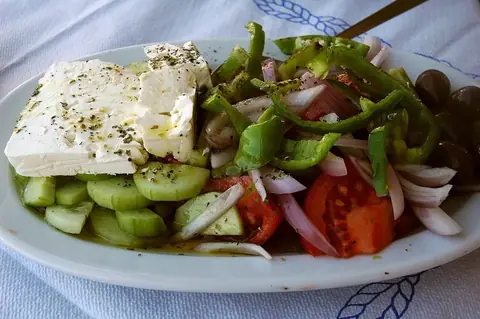
Horiatiki (choriátiki saláta, "village salad") is what the rest of the world calls Greek salad: chunks of tomato, cucumber, red onion, green pepper and Kalamata olives, topped with a whole slab of feta, dried oregano and plenty of olive oil. In Greece it has no lettuce. It's listed under salads and shared by the table.
- At a glance
- Horiatiki (Greek salad)
- Greek village salad of tomato, cucumber, onion, pepper, olives and a slab of feta.
- Pronunciation
- Say it like hor-YAH-tee-kee sah-LAH-tah · IPA /xoˈrʝatici saˈlata/
- Also written as
- choriatiki, horiatiki salata, χωριάτικη, Greek salad, village salad, classic Greek salad
What’s in it
Core ingredients
- ripe tomatoes in wedges
- cucumber
- red onion
- green bell pepper
- Kalamata olives
- feta cheese
- dried oregano
- olive oil
- salt
Often added
- capers or caper leaves (Cyclades)
- red wine vinegar
- barley rusk (paximádi) in some Cretan versions
- purslane in summer
Allergens
| Allergen | How likely |
|---|---|
| Dairy | Typically contains |
| Sulphites | Sometimes contains |
| Gluten | Rarely contains |
| Fish | Rarely contains |
| Eggs | Rarely contains |
| Peanuts | Rarely contains |
| Tree nuts | Rarely contains |
| Shellfish | Rarely contains |
| Soy | Rarely contains |
| Sesame | Rarely contains |
| Diet | Suitable? |
|---|---|
| Vegetarian | Depends — No meat or fish, but feta is traditionally made with animal rennet; strict vegetarians can ask for the salad without feta. |
| Vegan | Depends — Only without the feta: ask for it "χωρίς φέτα" (chorís féta). The rest of the salad is vegetables, olives and olive oil. |
| Pescatarian | Usually |
| Halal | Usually — No pork or alcohol in the salad itself; if animal rennet in cheese matters to you, ask for it without feta. |
| Kosher | Depends — Feta is a dairy product, so it fits kosher rules only away from meat and in a kosher kitchen. |
| Gluten-free | Usually |
Allergen and calorie details are AI estimates based on the menu and typical recipes. They can be incomplete — if you have a serious allergy, always check with the staff.
What's in a real horiatiki
A horiatiki is chunky and simple. Tomatoes are cut into wedges, cucumber into thick half-moons, and red onion and green pepper into thin rings. Kalamata olives go on top, then a rectangular slab of feta, a sprinkle of dried oregano and a generous pour of olive oil. Some tavernas add a splash of red wine vinegar, capers, or caper leaves, especially on the Cyclades islands.
There's no lettuce, and it isn't tossed: it arrives as built, and you break the feta yourself and mix it into the vegetables. The juice that collects at the bottom of the bowl is for mopping up with bread.
About the feta
Feta is a brined white cheese and a protected designation of origin in the EU: it must come from mainland Greece or Lesbos and be made from sheep's milk, or a mix of sheep's and up to 30% goat's milk. It's salty and crumbly, which is why the salad often needs no extra salt. Traditional feta is set with animal rennet, which matters to strict vegetarians. If you avoid dairy, ask for the salad without feta; the rest of the dish is vegetables, olives and olive oil.
Typical price
Median price 12 EUR
Typical range 7.5–17.5 EUR.
Median of 28 menus, 2025-05 – 2026-05. Basis: English-, Greek- and Italian-language menus priced in euros, scanned with MenuGuide.
How to order it
| Phrase | Romanization | Meaning |
|---|---|---|
| Μία χωριάτικη, παρακαλώ. | Mía choriátiki, parakaló. | One Greek salad, please. |
| Χωρίς κρεμμύδι, παρακαλώ. | Chorís kremmýdi, parakaló. | Without onion, please. |
| Χωρίς φέτα, παρακαλώ. Δεν τρώω γαλακτοκομικά. | Chorís féta, parakaló. Den tróo galaktokomiká. | Without feta, please. I don't eat dairy. |
Not to be confused with
- Dakos (ντάκος) — Cretan barley rusk topped with grated tomato and soft cheese; the rusk contains gluten.
- Maroulosaláta (μαρουλοσαλάτα) — Greek lettuce salad with spring onion and dill; no tomato or feta.
- "Greek salad" abroad — Often a lettuce salad with feta cubes and olives, unlike the lettuce-free Greek original.
Frequently asked questions
Does Greek salad have lettuce?
Not in Greece. The traditional horiatiki is tomato, cucumber, onion, green pepper, olives and feta, with no lettuce at all. Lettuce versions are common in other countries, where "Greek salad" often means greens with feta cubes and a dressing. Greek menus list lettuce salads separately, usually as maroulosaláta, with spring onion and dill.
Is Greek salad vegan?
Not as served, because it comes topped with a slab of feta, a sheep's-milk cheese. Everything else in a classic horiatiki is plant-based: vegetables, olives, oregano and olive oil. Ask for it "χωρίς φέτα" (chorís féta, without feta) and check that the dressing is only oil and vinegar.
Why is the feta served in one block?
It's the Greek way: the feta goes on top as a single slab so it stays creamy and you can break it up at the table. Pre-crumbled or cubed feta is more typical of Greek salads abroad. The block also makes it easy to spot, and to send back if you asked for the salad without cheese.
How do you pronounce horiatiki?
Say hor-YAH-tee-kee sah-LAH-tah, with the stress on YAH: in IPA, [xoˈrʝatici saˈlata]. The first sound is a throaty h, like the "ch" in Scottish "loch". Most Greeks just say "mía choriátiki" (one village salad) when they order. On English-language menus it is usually listed as Greek salad.