Dish guides
What is moussaka?
Μουσακάς · Mousakás
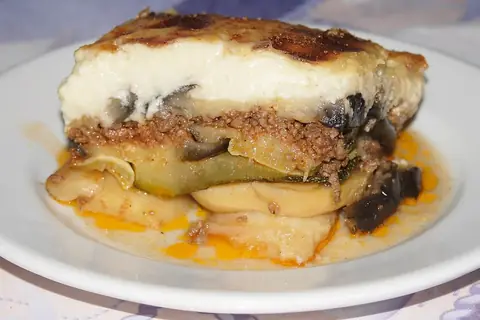
Moussaka is a Greek oven bake of fried aubergine slices, minced lamb or beef cooked in tomato with cinnamon and allspice, and a thick, golden layer of béchamel on top. Tavernas often add a base of sliced potato. It's listed among the main dishes, often as a "ready dish" (mageireftá) cooked in the morning and served in a square portion.
- At a glance
- Moussaka
- Greek bake of aubergine, spiced minced meat and a thick béchamel crust.
- Pronunciation
- Say it like moo-sah-KAHS · IPA /musaˈkas/
- Also written as
- mousaka, musaka, μουσακά, moussaka traditional, vegetarian moussaka
What’s in it
Core ingredients
- aubergine (eggplant), fried or baked in slices
- minced lamb or beef
- tomato, onion and garlic
- cinnamon, allspice or clove
- béchamel sauce (butter, flour, milk, usually egg)
- grated hard cheese (kefalotyri or similar)
Often added
- sliced potato as a bottom layer
- courgette (zucchini) slices
- red wine in the meat sauce
- breadcrumbs sprinkled between the layers
Allergens
| Allergen | How likely |
|---|---|
| Dairy | Typically contains |
| Gluten | Typically contains |
| Eggs | Typically contains |
| Sulphites | Sometimes contains |
| Celery | Rarely contains |
| Peanuts | Rarely contains |
| Tree nuts | Rarely contains |
| Shellfish | Rarely contains |
| Fish | Rarely contains |
| Soy | Rarely contains |
| Sesame | Rarely contains |
| Diet | Suitable? |
|---|---|
| Vegetarian | No |
| Vegan | No |
| Pescatarian | No |
| Halal | Depends — The classic recipe uses lamb or beef, not pork, but the meat is rarely halal-certified and the sauce often includes wine. |
| Kosher | No |
| Gluten-free | No |
Allergen and calorie details are AI estimates based on the menu and typical recipes. They can be incomplete — if you have a serious allergy, always check with the staff.
What's in a Greek moussaka
A moussaka is built in layers. Aubergine slices are fried or baked in olive oil until soft. Minced lamb or beef is cooked with onion, tomato and a little wine, and seasoned with warm spices such as cinnamon and allspice, which give the dish its distinctive, slightly sweet smell. A thick béchamel, made with butter, flour and milk and usually enriched with egg or egg yolk and grated cheese, is poured over the top before baking.
Many tavernas put a layer of sliced potato at the bottom, which helps the portion hold its shape when it's cut. Courgette slices sometimes join the aubergine. The finished dish is rich and filling: one square is a full main course.
Where moussaka comes from
Dishes called musakka exist across the eastern Mediterranean and the Balkans, and many of them have no white sauce at all. The version most people now picture as Greek, with its deep béchamel crust, is usually credited to the chef Nikolaos Tselementes, who brought French techniques into Greek cooking in the 1920s and whose cookbook shaped Greek home cooking for decades. That's why Greek moussaka can taste a little like a French gratin layered over a Balkan stew.
How to order it
| Phrase | Romanization | Meaning |
|---|---|---|
| Θα ήθελα έναν μουσακά, παρακαλώ. | Tha íthela énan mousaká, parakaló. | I'd like a moussaka, please. |
| Έχει αυγό η μπεσαμέλ; | Échei avgó i besamél? | Is there egg in the béchamel? |
| Έχει πατάτες από κάτω; | Échei patátes apó káto? | Does it have potatoes underneath? |
Not to be confused with
- Lasagne — Italian layered pasta with ragù and béchamel; moussaka has aubergine and often potato instead of pasta.
- Pastitsio (παστίτσιο) — Greek baked pasta with meat sauce and béchamel, closer to lasagne; no aubergine.
- Parmigiana di melanzane — Italian aubergine bake with tomato and cheese; no meat and no béchamel.
Frequently asked questions
Is moussaka gluten free?
Usually not. The béchamel is thickened with wheat flour, and some cooks scatter breadcrumbs between the layers. The aubergine, meat sauce and potatoes don't normally contain gluten, so a gluten-free moussaka is possible when it's made with a gluten-free white sauce, but tavernas rarely prepare one. Ask before ordering if you need to avoid gluten.
Does moussaka have potatoes?
Often, yes. Many Greek tavernas add a bottom layer of sliced potato under the aubergine, which makes the portion sturdier and more filling. Older and home-style recipes may use only aubergine, sometimes with courgette. If you'd rather know in advance, ask "Έχει πατάτες από κάτω;" (Does it have potatoes underneath?).
What's the difference between moussaka and lasagne?
Moussaka uses aubergine and often potato where lasagne uses sheets of pasta. Both have a meat sauce and a béchamel, but moussaka's meat is usually lamb or beef seasoned with cinnamon and allspice, while Italian ragù has no sweet spices. The Greek dish closest to lasagne is pastitsio, a baked pasta with meat sauce and béchamel.
How do you pronounce moussaka?
In Greek it's moo-sah-KAHS, with the stress on the last syllable: in IPA, [musaˈkas]. When you order it, the final s drops because of Greek grammar, so you'd ask for "énan mousaká". In English, many people say moo-SAH-kah, which waiters in Greece will understand without any trouble.