Dish guides
What are pimientos de Padrón?
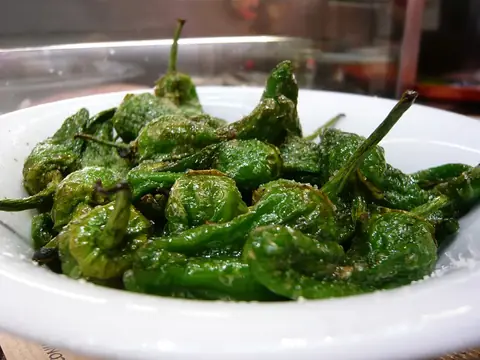
Pimientos de Padrón are small green peppers from Galicia, fried whole in olive oil until blistered and sprinkled with coarse salt. Most are mild and sweet, but now and then one is surprisingly hot. They're a classic sharing tapa, listed under tapas, raciones or verduras.
- At a glance
- Pimientos de Padrón
- Small green Galician peppers, blistered in olive oil and salted; some are hot.
- Pronunciation
- Say it like pee-MYEN-tohs deh pah-DRON · IPA /piˈmjentos ðe paˈðɾon/
- Also written as
- pimientos padrón, Padrón peppers, pementos de Padrón, pemento de Herbón, pimientos de Padrón fritos
What’s in it
Core ingredients
- small green Padrón peppers
- olive oil
- coarse sea salt
Often added
- bread on the side
Allergens
| Allergen | How likely |
|---|---|
| Gluten | Rarely contains |
| Dairy | Rarely contains |
| Eggs | Rarely contains |
| Peanuts | Rarely contains |
| Tree nuts | Rarely contains |
| Shellfish | Rarely contains |
| Fish | Rarely contains |
| Soy | Rarely contains |
| Sesame | Rarely contains |
| Diet | Suitable? |
|---|---|
| Vegetarian | Usually |
| Vegan | Usually |
| Pescatarian | Usually |
| Halal | Usually |
| Kosher | Depends — The ingredients are plant-based, but restaurants in Spain are rarely kosher-certified. |
| Gluten-free | Usually |
Allergen and calorie details are AI estimates based on the menu and typical recipes. They can be incomplete — if you have a serious allergy, always check with the staff.
From Padrón, in Galicia
The peppers come from the area around the town of Padrón in the province of A Coruña, especially the parish of Herbón, where they have long been grown. Since 2010, peppers grown there under the protected designation of origin are sold as Pemento de Herbón. Today the same variety is also grown elsewhere, so pimientos de Padrón on a menu describes the kind of pepper; it doesn't prove where it was grown.
They're picked small and green, a few centimetres long. The heat is famously unpredictable, summed up in the Galician saying "Os pementos de Padrón, uns pican e outros non": Padrón peppers, some are hot and some are not. Peppers left longer on the plant, or grown under dry conditions, tend to be hotter.
On the plate
They arrive as a pile of glossy, blistered peppers, softened and slightly collapsed, with flakes of salt on top. You pick them up by the stem and eat everything except the stem. Expect a grassy, slightly sweet flavour, and every so often a hot one.
Pimientos de Padrón are usually pan-fried rather than deep-fried, and are served as a ración to share or a media ración (half portion). They go well with seafood dishes such as pulpo a la gallega and are on tapas menus all over Spain. For portion sizes, see the Spain menu guide.
Typical price
Median price 7.5 EUR
Typical range 5–9 EUR.
Median of 25 menus, 2025-04 – 2026-04. Basis: Spanish- and English-language menus priced in euros, scanned with MenuGuide.
How to order it
| Phrase | Meaning |
|---|---|
| Una ración de pimientos de Padrón, por favor. | A portion of Padrón peppers, please. |
| ¿Pican mucho hoy? | Are they very hot today? |
| ¿Los fríen en el mismo aceite que el pescado? | Do you fry them in the same oil as the fish? |
Not to be confused with
- Pimientos del piquillo — Red peppers from Navarre, roasted and peeled, often stuffed; sweet, not fried whole.
- Guindillas / piparras — Long, thin chillies, usually pickled; piparras from the Basque Country are mild, guindillas can be hot.
- Shishito peppers — A very similar small green Japanese pepper, cooked the same way.
Frequently asked questions
Are Padrón peppers spicy?
Most aren't: the majority are mild and slightly sweet. A few in each plate can be noticeably hot, and there's no way to tell by looking. That's the fun of the dish, as the Galician saying goes: some are hot and some are not. If you're very sensitive to chilli, take small bites.
How do you eat pimientos de Padrón?
Pick each pepper up by its stem and eat it whole, seeds and all, leaving only the stem. They're finger food, usually shared from one plate in the middle of the table. Some people eat them with bread. In the Padrón area cooks sometimes remove the stems before frying, in which case you'll need a fork.
Are pimientos de Padrón vegan?
Usually, yes. They're just green peppers, olive oil and salt, so the dish is typically vegan and gluten free. The only common caveat is the cooking oil: some busy bars fry them in a deep-fat fryer shared with fish, battered squid or meat. Ask if that matters to you.
What's the difference between Padrón and shishito peppers?
They're very similar: both are small green peppers eaten unripe, blistered in oil and salted, and both are mostly mild with the occasional hot one. Padrón peppers come from Galicia in Spain and shishito peppers from Japan; they're different varieties, but they're cooked and eaten in almost exactly the same way.