Dish guides
What is tarte Tatin?
Tarte Tatin is a French upside-down apple tart. Apples are caramelized in butter and sugar, covered with pastry and baked, then turned out so the glossy apples end up on top. It's a classic dessert in bistros and brasseries, usually served warm with crème fraîche or vanilla ice cream.
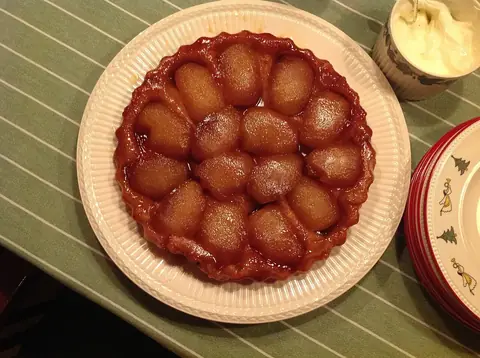
- At a glance
- Tarte Tatin
- Upside-down tart of butter-and-sugar caramelized apples on a pastry base.
- Pronunciation
- Say it like tart tah-TAN · IPA /taʁt tatɛ̃/
- Also written as
- tarte tatin, tarte tatin et sa crème fraîche, tatin, tatin aux pommes, upside-down apple tart
What’s in it
Core ingredients
- apples
- butter
- sugar
- puff pastry or shortcrust pastry
Often added
- crème fraîche
- vanilla ice cream
- Calvados or another spirit
- vanilla or cinnamon
- pears, quince or other fruit instead of apples
Allergens
| Allergen | How likely |
|---|---|
| Gluten | Typically contains |
| Dairy | Typically contains |
| Eggs | Often contains |
| Sulphites | Rarely contains |
| Tree nuts | Rarely contains |
| Peanuts | Rarely contains |
| Shellfish | Rarely contains |
| Fish | Rarely contains |
| Soy | Rarely contains |
| Sesame | Rarely contains |
| Diet | Suitable? |
|---|---|
| Vegetarian | Usually |
| Vegan | No |
| Pescatarian | Usually |
| Halal | Depends — Usually just apples, butter, sugar and pastry, but some kitchens add Calvados or another spirit to the caramel or flambé it; ask if you avoid alcohol. |
| Kosher | Depends — Contains butter and is often served with cream; it is kosher only when it comes from a kosher-certified kitchen. |
| Gluten-free | No |
Allergen and calorie details are AI estimates based on the menu and typical recipes. They can be incomplete — if you have a serious allergy, always check with the staff.
How a tarte Tatin is made
The cook melts butter and sugar in a heavy pan, packs in quartered or halved apples and lets them cook until the caramel turns deep amber and the apples soften. A round of pastry goes over the top and the whole pan goes into the oven. Once baked, the tart is flipped onto a plate, so the pastry becomes the base and the caramelized apples sit on top.
Restaurants use either puff pastry or shortcrust (pâte brisée). Puff pastry usually contains no egg, while some shortcrust and sweet pastry recipes do, which is why eggs are an "often" rather than a certainty. Firm apples that hold their shape are preferred, and some kitchens use pears, quince or even savoury versions with onions or tomatoes.
The Tatin sisters
The tart is named after Stéphanie and Caroline Tatin, who ran the Hôtel Tatin in Lamotte-Beuvron, in the Sologne about 170 km south of Paris, in the late 19th century. The popular story says Stéphanie overcooked apples for a pie and rescued them by putting the pastry on top and baking the tart upside down. Historians point out that upside-down fruit tarts already existed in the region, so the sisters may have refined a local tart rather than invented it. It was the hotel's signature dessert, and the name "tarte Tatin" spread through Paris food writers and restaurants after the sisters' time.
Typical price
Median price 10 EUR
Typical range 7–18 EUR.
Median of 25 menus, 2025-04 – 2026-05. Basis: French-, English- and Spanish-language menus priced in euros, scanned with MenuGuide.
How to order it
| Phrase | Meaning |
|---|---|
| Une tarte Tatin avec de la crème fraîche, s'il vous plaît. | A tarte Tatin with crème fraîche, please. |
| Elle est servie chaude ? | Is it served warm? |
| Est-ce qu'il y a des œufs dans la pâte ? | Are there eggs in the pastry? |
Not to be confused with
- Tarte aux pommes — A regular apple tart: pastry on the bottom, sliced apples arranged on top, no caramel flip.
- Tarte fine aux pommes — A thin sheet of puff pastry with very thin apple slices, baked crisp; not caramelized upside down.
- Crème brûlée — A baked vanilla custard with a burnt-sugar crust; caramel, but no fruit or pastry.
Frequently asked questions
Is tarte Tatin served hot or cold?
It's usually served warm or at room temperature, rarely straight from the fridge. Warm caramel and soft apples are part of the appeal, and a cold spoonful of crème fraîche or vanilla ice cream on top makes the contrast. If you'd like it warm, you can ask "Elle est servie chaude ?" (Is it served warm?).
Does tarte Tatin contain eggs?
Often, but not always. The apples, butter and sugar contain no egg, and puff pastry is normally made without it. Many shortcrust and sweet pastries do use egg, though, and ice cream served on the side often contains egg yolks. If you avoid eggs, ask which pastry the kitchen uses and skip the ice cream.
What is the difference between tarte Tatin and apple pie?
Tarte Tatin is baked upside down: the apples caramelize in butter and sugar in the pan under a single layer of pastry, and the tart is flipped after baking. Apple pie usually has raw apples between two pastry crusts. Tarte Tatin is darker, stickier and more caramel-tasting, with no pastry on top.
How do you pronounce tarte Tatin?
Say "tart tah-TAN", with a nasal final vowel and no clear n sound at the end, in IPA [taʁt tatɛ̃]. The French r in tarte is soft and made at the back of the throat. Tatin is a family name, so it's often written with a capital T.