Dish guides
What is crème brûlée?
Crème brûlée ("burnt cream") is a French dessert of rich, chilled custard made from cream, egg yolks and sugar, topped with a thin layer of sugar caramelised until it sets into a glassy crust. You crack the top with your spoon. It sits in the desserts section of most French brasserie and bistro menus.
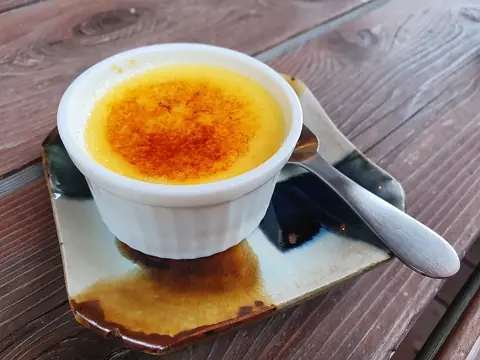
- At a glance
- Crème brûlée
- Chilled vanilla custard with a crackly caramelised sugar top.
- Pronunciation
- Say it like krem broo-LAY · IPA /kʁɛm bʁyle/
- Also written as
- creme brulee, la crème brûlée, crème brûlée à la vanille, crème brûlée à la vanille Bourbon, burnt cream
What’s in it
Core ingredients
- cream (sometimes part milk)
- egg yolks
- sugar
- vanilla
- sugar for the caramel top
Often added
- other flavourings such as chicory, coffee, lavender or tonka bean
- fresh berries
- a biscuit or tuile on the side
Allergens
| Allergen | How likely |
|---|---|
| Dairy | Typically contains |
| Eggs | Typically contains |
| Gluten | Sometimes contains |
| Tree nuts | Sometimes contains |
| Peanuts | Rarely contains |
| Shellfish | Rarely contains |
| Fish | Rarely contains |
| Soy | Rarely contains |
| Sesame | Rarely contains |
| Diet | Suitable? |
|---|---|
| Vegetarian | Usually |
| Vegan | No |
| Pescatarian | Usually |
| Halal | Depends — Usually just cream, egg yolks, sugar and vanilla, but vanilla extract contains alcohol and some flavoured versions add a liqueur; ask if you avoid alcohol. |
| Kosher | Depends — The ingredients are dairy and usually kosher-compatible, but restaurant kitchens in France are rarely kosher-certified. |
| Gluten-free | Usually |
Allergen and calorie details are AI estimates based on the menu and typical recipes. They can be incomplete — if you have a serious allergy, always check with the staff.
What's in it and how it's made
The base is simple: cream (sometimes mixed with milk), egg yolks, sugar and vanilla. The custard is baked gently in a shallow dish in a water bath until it just sets, then chilled. Just before serving, the cook scatters sugar over the top and melts it with a blowtorch or under a very hot grill until it turns amber and hardens.
A good one has a thin crust that shatters, a cold, smooth custard underneath and a faint bitterness from the caramel. Vanilla is the classic flavour, but menus also list coffee, chicory, lavender, pistachio or tonka bean versions. Flavoured versions, and the almond tuiles sometimes served alongside, are worth asking about if you avoid nuts.
Where crème brûlée comes from
The earliest known recipe under the name crème brûlée appears in François Massialot's cookbook of 1691, though the idea of browning a custard with a hot iron is older. England has its own "burnt cream", long associated with Trinity College, Cambridge, and Catalonia has the very similar crema catalana. The dessert was not especially common in the 19th and 20th centuries and became a restaurant favourite in the 1980s.
Typical price
Median price 8 EUR
Typical range 6.5–11 EUR.
Median of 32 menus, 2025-04 – 2026-04. Basis: French-language menus scanned with MenuGuide.
How to order it
| Phrase | Meaning |
|---|---|
| Je vais prendre la crème brûlée, s'il vous plaît. | I'll have the crème brûlée, please. |
| Elle est parfumée à quoi ? | What is it flavoured with? |
| Est-ce qu'il y a des fruits à coque ? | Are there any nuts in it? |
Not to be confused with
- Crema catalana — The Catalan cousin: usually made with milk rather than cream, flavoured with lemon zest and cinnamon, and thickened on the stove.
- Crème caramel — A set custard turned out of its mould, with soft liquid caramel instead of a hard sugar crust.
- Crème anglaise — A pourable vanilla custard sauce, not a set dessert.
Frequently asked questions
Is crème brûlée gluten free?
Usually, yes. The classic recipe uses only cream, egg yolks, sugar and vanilla, with no flour. Gluten can come in through a biscuit or tuile served on the side, or a flavouring added by the kitchen. If you need to avoid gluten strictly, ask about the garnish and say you'd like it served without the biscuit.
Does crème brûlée have eggs?
Yes. Egg yolks are what set the custard, so eggs are a core ingredient of every traditional crème brûlée, alongside cream. Egg-free versions thickened with starch or agar exist, but they're rare in restaurants. If you're allergic to eggs, crème brûlée is one of the desserts to skip in France.
How do you pronounce crème brûlée?
Say krem broo-LAY: in IPA, [kʁɛm bʁyle]. The first word rhymes with "them", and the second has the French "u" sound, made by saying "ee" with rounded lips. The French r is pronounced at the back of the throat, and the stress falls lightly on the last syllable.
What's the difference between crème brûlée and crema catalana?
They look almost identical, with a burnt-sugar top over custard, but the base differs. Crème brûlée is usually made with cream and vanilla and baked in a water bath. Crema catalana is typically made with milk, flavoured with lemon zest and cinnamon, and thickened on the stove, often with a little starch.