
Dish guides
What is carne de porco à alentejana?
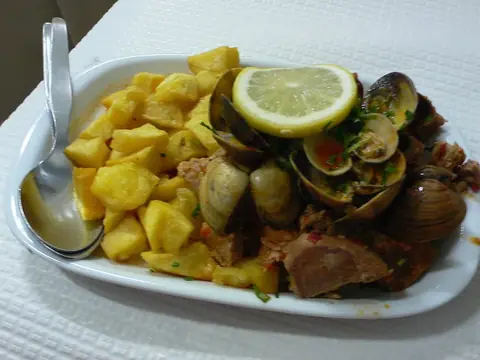
Carne de porco à alentejana is a Portuguese classic that pairs land and sea: cubes of pork marinated in white wine, garlic and red pepper paste, fried, then tossed with clams until they open, and finished with fried potato cubes and fresh coriander. Despite the name, it's eaten all over Portugal and its origin is disputed.
- At a glance
- Carne de porco à alentejana
- Pork marinated in wine and red pepper paste, cooked with clams and topped with fried potatoes.
- Pronunciation
- Say it like KAR-nuh duh POR-koo ah uh-len-tuh-ZHAH-nuh · IPA /ˈkaɾnɨ dɨ ˈpoɾku a ɐlẽtɨˈʒɐnɐ/
- Also written as
- porco à alentejana, carne de porco alentejana, pork with clams, pork Alentejo style, carne de porco com amêijoas
What’s in it
Core ingredients
- pork (loin or shoulder) in cubes
- clams (amêijoas)
- white wine
- garlic
- massa de pimentão (red pepper paste) or paprika
- bay leaf
- fried potato cubes
- fresh coriander
Often added
- lard or olive oil for frying
- cumin (often added in the north)
- pickled vegetables (pickles) on top
- lemon wedges
- roast or boiled potatoes instead of fried
Allergens
| Allergen | How likely |
|---|---|
| Molluscs | Typically contains |
| Sulphites | Often contains |
| Gluten | Rarely contains |
| Celery | Rarely contains |
| Shellfish | Rarely contains |
| Fish | Rarely contains |
| Dairy | Rarely contains |
| Eggs | Rarely contains |
| Peanuts | Rarely contains |
| Tree nuts | Rarely contains |
| Soy | Rarely contains |
| Sesame | Rarely contains |
| Diet | Suitable? |
|---|---|
| Vegetarian | No |
| Vegan | No |
| Pescatarian | No |
| Halal | No |
| Kosher | No |
| Gluten-free | Usually — Pork, clams, wine, garlic and fried potatoes don't normally contain gluten, but fries can share a fryer with breaded food, and a few cooks dust the meat with flour; ask if you're coeliac. |
Allergen and calorie details are AI estimates based on the menu and typical recipes. They can be incomplete — if you have a serious allergy, always check with the staff.
What goes into it
Cubes of pork are marinated for several hours or overnight in white wine, garlic, bay leaf and massa de pimentão, a salty red pepper paste that gives the dish its colour. The meat is then fried until golden, often in lard. Clams go into the hot pan with the marinade and cook until their shells open, releasing their juices into a light sauce.
The dish is finished with cubes of fried potato, chopped coriander and sometimes pickled vegetables and lemon. The mix of rich pork and briny clams is the whole idea: neither is a garnish. In northern Portugal some cooks add cumin to the marinade.
Is it really from the Alentejo?
Not necessarily. The Alentejo is mostly inland farm country with a meat-based cuisine and few fishing ports, while clams are a coastal food, so the origin is disputed. One common account places it in the Algarve, where cooks are said to have used the name to show that the pork came from the Alentejo, whose acorn-fed pigs were prized. Others link it to Alverca, near Lisbon, or see it simply as inland pork meeting coastal seafood. None of these is documented. In the Alentejo itself it's often called carne de porco com amêijoas.
Today it's on menus throughout Portugal, usually among the meat mains (pratos de carne), often in a full portion meant for one hungry person or a meia dose (half portion). See the Portugal menu guide for portion sizes and other dishes.
How to order it
| Phrase | Meaning |
|---|---|
| Queria uma carne de porco à alentejana, por favor. | I'd like the pork with clams, please. |
| Leva amêijoas? | Does it come with clams? (The classic dish always does.) |
| As batatas são fritas na mesma fritadeira que os panados? | Are the potatoes fried in the same fryer as breaded food? |
Not to be confused with
- Cataplana — A stew cooked in a closed copper pan; pork with clams is one common filling, usually with peppers and tomato.
- Amêijoas à Bulhão Pato — Clams with garlic, olive oil, coriander and lemon, served as a starter; no pork.
- Rojões — Fried marinated pork chunks from the Minho, often with potatoes and blood sausage; no clams.
Frequently asked questions
Does carne de porco à alentejana always have clams?
Yes, in the classic recipe the clams are essential, and they're cooked in the same pan as the pork. If you're allergic to molluscs or don't eat shellfish, choose another pork dish instead of asking for it without clams, since the sauce is made with their juices.
Is there alcohol in carne de porco à alentejana?
The pork is marinated in white wine, and the marinade usually goes into the pan with the clams. Cooking drives off much of the alcohol, but not necessarily all of it, and wine also brings sulphites. The dish combines pork and shellfish, so it isn't suitable for halal or kosher diets either.
What is massa de pimentão?
Massa de pimentão is a Portuguese paste of sweet red peppers and salt, used as a seasoning in marinades for meat and fish, especially pork. It gives carne de porco à alentejana its reddish colour and a sweet, salty flavour. Some cooks use paprika (colorau) instead. Because it's made from sweet peppers, it isn't hot.
How do you pronounce carne de porco à alentejana?
Say KAR-nuh duh POR-koo ah uh-len-tuh-ZHAH-nuh: in IPA, [ˈkaɾnɨ dɨ ˈpoɾku a ɐlẽtɨˈʒɐnɐ]. The j sounds like the s in "measure", and the final e of carne and de is barely pronounced. Waiters will also understand just "porco à alentejana".

.jpg)