Dish guides
What are chiles en nogada?
Chiles en nogada are roasted poblano chillies stuffed with a sweet-savoury mix of minced meat and fruit, covered in a cold, creamy walnut sauce (nogada) and scattered with pomegranate seeds and parsley. The green, white and red echo the Mexican flag. It's a seasonal speciality of Puebla, served in August and September, at room temperature.
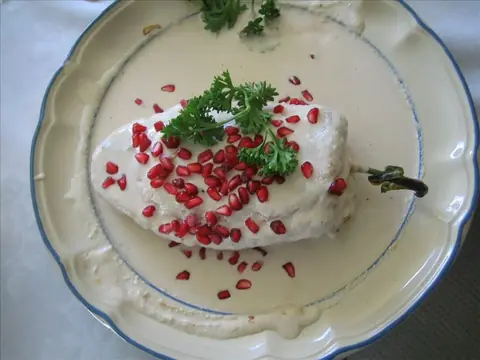
- At a glance
- Chiles en nogada
- Poblano chillies stuffed with meat and fruit, under walnut cream and pomegranate seeds.
- Pronunciation
- Say it like CHEE-lehs en noh-GAH-dah · IPA /ˈtʃiles en noˈɣaða/
- Also written as
- chile en nogada, chiles en nogada poblanos, chile en nogada capeado, chile en nogada sin capear
What’s in it
Core ingredients
- poblano chillies, roasted and peeled
- picadillo of minced or shredded pork and/or beef
- fruit such as apple, pear, peach and plantain
- raisins, almonds and often pine nuts
- nogada: fresh walnuts blended with milk or cream and fresh cheese
- pomegranate seeds
- parsley
Often added
- egg batter, fried (capeado)
- sherry or other alcohol in the sauce
- candied fruit (acitrón, now often candied pineapple)
- goat's cheese in the nogada
- pecans with or instead of walnuts
- cinnamon and clove in the filling
Allergens
| Allergen | How likely |
|---|---|
| Tree nuts | Typically contains |
| Dairy | Typically contains |
| Eggs | Often contains |
| Sulphites | Often contains |
| Gluten | Sometimes contains |
| Peanuts | Rarely contains |
| Shellfish | Rarely contains |
| Fish | Rarely contains |
| Soy | Rarely contains |
| Sesame | Rarely contains |
| Diet | Suitable? |
|---|---|
| Vegetarian | Depends — The classic filling is meat. Some restaurants offer a vegetarian chile en nogada filled with fruit, vegetables and nuts; ask whether it's cooked in lard. The fresh cheese in the nogada may be made with animal rennet. |
| Vegan | Depends — Very rarely available: the nogada is made with milk or cream and cheese, and capeado versions use egg. |
| Pescatarian | Depends — Only a vegetarian version, since the standard filling is pork and beef. |
| Halal | Depends — The filling usually includes pork and the sauce often contains sherry, so the classic recipe isn't halal; a beef-only, alcohol-free version would be a special request. |
| Kosher | No |
| Gluten-free | Depends — The chilli, filling and walnut sauce don't normally contain gluten, but the egg batter of capeado versions is often dusted with wheat flour. |
Allergen and calorie details are AI estimates based on the menu and typical recipes. They can be incomplete — if you have a serious allergy, always check with the staff.
What's in chiles en nogada
Large poblano chillies are charred, peeled and seeded, then filled with picadillo: minced or shredded pork and beef cooked with onion, garlic and tomato and mixed with chopped fruit (apple, pear, peach, plantain), raisins and nuts such as almonds and pine nuts. Cinnamon and clove make it gently sweet. Some cooks dip the stuffed chilli in beaten egg and fry it (capeado); others serve it plain, and Puebla families argue about which is right.
The nogada is made from fresh walnuts, peeled by hand, blended with milk or cream and fresh cheese, sometimes with a splash of sherry. It's poured cold over the chilli, so the dish is served at room temperature. Pomegranate seeds and parsley finish it.
A late-summer dish from Puebla
Chiles en nogada belong to late July, August and September, when fresh walnuts and pomegranates are in season, and many restaurants in Puebla only serve them then. That's also the run-up to Independence Day on 16 September, which is why the flag colours matter. A well-known story says nuns in Puebla created the dish in 1821 for Agustín de Iturbide after the Treaty of Córdoba. Historians, including researchers at Mexico's National Institute of Anthropology and History (INAH), doubt it: they say similar stuffed chillies with walnut sauce existed earlier, and the link to the flag colours seems to have spread only in the 20th century.
Because of the hand-peeled walnuts and long list of ingredients, it's usually one of the priciest dishes on the menu. See the Mexico menu guide for other Puebla dishes, including mole poblano.
Nuts in every part
Tree nuts are central to this dish. The sauce is made of walnuts (sometimes pecans), and the filling usually contains almonds and often pine nuts. If you have a tree-nut allergy, this isn't a dish to adapt; choose something else and mention the allergy, since kitchens that make nogada handle large amounts of nuts in season.
How to order it
| Phrase | Meaning |
|---|---|
| Un chile en nogada, por favor. | One chile en nogada, please. |
| ¿Viene capeado o sin capear? | Is it fried in egg batter or not? |
| ¿El relleno lleva carne de puerco? ¿Y la nogada lleva jerez? | Is there pork in the filling? And is there sherry in the walnut sauce? |
| Tengo alergia a las nueces y a otros frutos secos. | I'm allergic to walnuts and other nuts. |
Not to be confused with
- Chile relleno — A poblano usually stuffed with cheese or meat, fried in egg batter and served hot in tomato sauce; no walnut sauce or fruit.
- Mole poblano — Puebla's other famous dish: a dark sauce of chillies, spices, nuts and chocolate served over meat.
Frequently asked questions
When are chiles en nogada in season?
Mainly from late July to September. That's when fresh walnuts and pomegranates are harvested in central Mexico, and it coincides with the Independence Day celebrations in mid-September. Some restaurants serve them all year with stored nuts, but in Puebla many treat it as a strictly seasonal dish.
Are chiles en nogada spicy?
Usually not. Poblano chillies are mild, and roasting and seeding them takes away most of the heat, while the fruit filling and cold walnut sauce make the dish sweet and creamy. Now and then a poblano is hotter than expected, but it's one of the gentlest Mexican chilli dishes.
Are chiles en nogada served hot or cold?
At room temperature. The stuffed chilli is usually warm or at room temperature, and the walnut sauce is poured over cold, so the dish never arrives piping hot. That's intentional, not a mistake in the kitchen, and it's how it's served in Puebla.
How do you pronounce chiles en nogada?
Say CHEE-lehs en noh-GAH-dah: in IPA, [ˈtʃiles en noˈɣaða]. The g in nogada is soft, said without fully closing the throat, and the d sounds like the th in "this". Nogada comes from nogal, the Spanish word for the walnut tree.