Dish guides
What is a bifana?
A bifana is Portugal's classic hot pork sandwich: thin slices of pork marinated and simmered in garlic, white wine and paprika, tucked into a crusty white roll, usually with a squeeze of yellow mustard or hot sauce. It's a cheap, quick snack sold at cafés, beer halls and festival stands, often with a small draught beer.
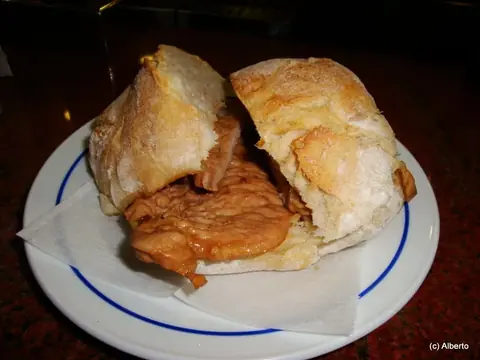
- At a glance
- Bifana
- Thin pork slices simmered in garlic and white wine, served hot in a crusty roll.
- Pronunciation
- Say it like bee-FAH-nuh · IPA /biˈfɐnɐ/
- Also written as
- bifanas, bifana no pão, bifana no prato, bifana à moda do Porto, bifana de Vendas Novas, sandes de bifana
What’s in it
Core ingredients
- thin pork slices (loin or leg)
- garlic
- white wine
- paprika or red pepper paste
- bay leaf
- white bread roll (papo-seco)
Often added
- yellow mustard
- piri-piri or another hot sauce
- lard for frying
- a spicier sauce, sometimes with tomato (Porto style)
- fried egg or cheese
- sautéed onions
Allergens
| Allergen | How likely |
|---|---|
| Gluten | Typically contains |
| Mustard | Often contains |
| Sulphites | Often contains |
| Eggs | Sometimes contains |
| Dairy | Sometimes contains |
| Sesame | Rarely contains |
| Soy | Rarely contains |
| Celery | Rarely contains |
| Peanuts | Rarely contains |
| Tree nuts | Rarely contains |
| Shellfish | Rarely contains |
| Fish | Rarely contains |
| Diet | Suitable? |
|---|---|
| Vegetarian | No |
| Vegan | No |
| Pescatarian | No |
| Halal | No |
| Kosher | No |
| Gluten-free | Depends — The pork itself is usually gluten-free, but the roll is wheat bread. A few places serve a bifana no prato (on a plate, without bread); ask whether the sauce is thickened with flour. |
Allergen and calorie details are AI estimates based on the menu and typical recipes. They can be incomplete — if you have a serious allergy, always check with the staff.
What goes into a bifana
The pork is cut or pounded thin, then marinated with garlic, white wine, paprika and bay leaf, and cooked in that liquid, often with a little lard, until tender. The slices go into a split, crusty white roll called a papo-seco, sometimes dipped in the cooking juices so the bread soaks them up. Yellow mustard is the usual finish, and most counters keep piri-piri or another hot sauce next to it.
Styles differ. In the south, bifanas tend to be simple, with a lightly marinated cutlet. Vendas Novas in the Alentejo is usually named as the bifana's home, though nearby villages also claim it. In Porto and the north, the meat is often thinner, almost shredded, and served with more sauce, which in some cafés is noticeably spicy.
How to order it
| Phrase | Meaning |
|---|---|
| Uma bifana e uma imperial, por favor. | A bifana and a small draught beer, please. (In Porto, ask for a fino instead of an imperial.) |
| Com mostarda, por favor. | With mustard, please. |
| Sem mostarda, por favor. Tenho alergia. | No mustard, please. I'm allergic. |
Not to be confused with
- Prego — The beef version: a thin garlic steak in a roll, often finished with mustard or a fried egg.
- Francesinha — Porto's knife-and-fork sandwich of several meats under melted cheese and a beer-and-tomato sauce.
- Sandes de leitão — A roll filled with roast suckling pig and its peppery sauce, a speciality of the Bairrada region.
Frequently asked questions
What's the difference between a bifana and a prego?
A bifana is pork; a prego is beef. Both are hot sandwiches in a crusty roll and both are marinated with garlic, but the bifana's thin pork slices are simmered in white wine and paprika, while a prego is a thin beef steak fried with garlic, often with mustard. A prego no prato is served on a plate, often with an egg.
Is a bifana spicy?
Usually not on its own. The pork is seasoned with garlic, wine and paprika, which is mild. The heat comes from the hot sauce or piri-piri you add yourself. In Porto and the north, some cafés serve bifanas in a spicier sauce, so ask "É picante?" (Is it spicy?) if you're unsure.
Does a bifana contain alcohol?
The marinade traditionally uses white wine, so yes, in small amounts. Simmering drives off much of the alcohol, but not necessarily all of it, and the wine also brings sulphites. If you avoid alcohol for religious or health reasons, a bifana isn't a good choice; it's also pork, so it isn't halal or kosher.
How do you pronounce bifana?
Say bee-FAH-nuh, with the stress on the middle syllable: in IPA, [biˈfɐnɐ]. The final a is very short and soft, almost swallowed, as is typical in European Portuguese. The plural, bifanas, is how you'll often see it on café boards.